Introduction
Your donors' inboxes are full. The average nonprofit email open rate sits at 28.59%, according to AFP — meaning roughly seven out of ten recipients never see the message at all. Meanwhile, a physical postcard lands in the mailbox and gets handled, read, and considered in a way digital messages rarely are.
According to the USPS Household Diary Study, households interact with nearly 80% of the advertising mail they receive, with many pieces staying in the home for days — giving your message repeated exposure that an email simply can't match.
That staying power is exactly why nonprofits, charities, and community organizations — particularly those in Dallas-Fort Worth — are turning back to postcards. This guide walks you through the full campaign process: understanding why postcards work as a fundraising vehicle, designing and executing a campaign from list to mailbox, and measuring results so each campaign outperforms the last.
Key Takeaways
- Direct mail is read by 76.5% of recipients — far outpacing the average nonprofit email open rate of 28.59%.
- Every effective fundraising postcard combines a targeted list, a single clear CTA, strong visuals, and a trackable response mechanism.
- Personalization matters — 97% of businesses report higher response rates with personalized direct mail vs. generic pieces.
- Postcards perform best paired with email follow-ups and personal outreach — a multi-channel approach consistently outperforms solo mailings.
What Are Direct Mail Fundraising Postcards (and Why Do They Work)?
The Format, Defined
A fundraising postcard is a printed card mailed directly to prospects or existing donors. It contains a donation appeal, a clear call-to-action, and a response mechanism — no envelope required. Unlike letter packages, postcards are immediately visible on both sides. There's nothing to open, no envelope to trash before reading. Your mission, image, and ask are seen the moment the piece is picked up.
Key differences from letter packages:
- Lower production cost — no envelope, no letter folding, simpler preparation
- Faster production timeline — fewer components to coordinate
- Immediate visibility — both sides read before any engagement decision is made
The Budget Case for Nonprofits
Those format advantages come with a financial one, too — postcards are among the most cost-efficient direct mail options available to nonprofits. They qualify for USPS Marketing Mail at nonprofit rates — organizations apply using PS Form 3624 with evidence of nonprofit status (IRS exemption letter or audited financials). Note that IRS nonprofit status alone doesn't automatically qualify you; you must apply separately.
At current USPS rates (effective April 26, 2026), the difference is meaningful:
- Nonprofit saturation letter rate: $0.155 per piece
- Commercial saturation letter rate: $0.244 per piece
That's roughly a 36% postage savings — which adds up fast at scale.
Why Physical Mail Creates Stronger Donor Recall
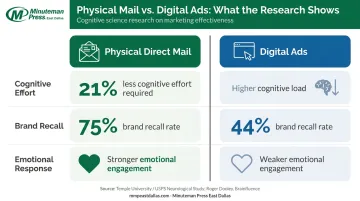
There's solid research behind why postcards work for emotional fundraising. A Canada Post/True Impact study found that physical direct mail:
- Required 21% less cognitive effort to process than digital media
- Produced 75% brand recall vs. 44% for digital ads
- Generated stronger emotional response tied to the physical act of holding the piece
Donors set a postcard on the counter. They come back to it later. That kind of passive persistence simply doesn't exist with digital outreach.
How to Design a High-Performing Fundraising Postcard
Keep the Message Focused
Postcard real estate is limited. Every design decision — headline, image, copy, CTA — must serve a single message. The most common design failure is treating the postcard like a brochure: multiple program descriptions, several donation amounts, a list of upcoming events. That approach fragments attention and kills response.
Rule of thumb: If someone can't understand your ask in under 10 seconds, redesign it.
Choosing Your Size
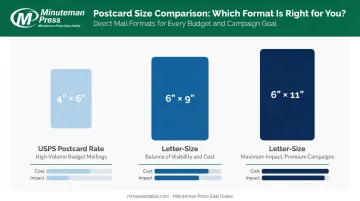
| Size | Classification | Best For |
|---|---|---|
| 4" × 6" | USPS postcard rate | High-volume, budget-conscious mailings |
| 6" × 9" | Letter-size mail | Balance of visibility and cost |
| 6" × 11" | Letter-size mail | Maximum impact, premium campaigns |
Larger formats command more attention in the mailbox and give you room for emotionally compelling photography, a QR code, and a clear CTA. They cost more to print and mail, but for campaigns targeting high-value donors, the extra investment is often justified. Test both sizes against your budget and audience before committing to scale.
Minuteman Press East Dallas prints all three sizes on 14pt coated stock (C1S or C2S). The stock holds color well and feels substantial in the hand, which matters for donor perception.
The Front: Lead with Emotion
Your front panel should do one thing: stop the recipient from setting the piece down.
- Use real photography — beneficiaries, volunteers, impact in action. Authentic images outperform stock every time.
- Write a bold, short headline that names the problem your nonprofit solves. Not "Annual Appeal" — something like "A child in Garland goes to bed hungry tonight."
- White space is not wasted space — a cluttered front panel loses to a focused one.
The Back: Make the Ask Clear
Once the front stops the reader, the back has to close them. Keep the appeal tight and the path to giving obvious:
- 3–5 sentences of conversational copy — write like you're talking to a friend, not filing a grant report
- A specific dollar ask tied to real impact: "$50 feeds a family of four for a week"
- A single, unmissable CTA — "Scan to give now" or "Donate at [URL]"
- Two response options: a QR code to your donation page, plus a short URL for anyone who'd rather type it
For DFW nonprofits, Minuteman Press East Dallas handles design, printing, and mailing end-to-end — a meaningful advantage for small teams that can't coordinate multiple vendors while running a fundraising campaign.
Running Your Fundraising Postcard Campaign Step by Step
Successful postcard campaigns aren't one-off sends. They're planned sequences with defined goals, clean lists, and deliberate follow-up.
Step 1: Define Your Goal and Audience Segment
Your campaign goal determines your message tone, list source, and success metrics. Three common nonprofit scenarios:
- New donor acquisition — cold or warm prospects who need mission context before they'll give
- Lapsed donor reactivation — past supporters who need proof that their previous gift made a difference
- Mid-level donor upgrades — active givers who can be asked to increase their gift size
This connects to what fundraisers call the 80/20 principle: roughly 80% of donations come from 20% of donors. Postcards let you allocate more budget — larger format, personalized messaging, follow-up phone calls — to your highest-value segment, rather than treating everyone identically.
Step 2: Build, Source, and Clean Your Mailing List
Three list sources available to nonprofits:
- Internal donor database — your best starting point; these people already have a relationship with you
- Purchased or rented lists — targeted by geography, demographics, household income, or charitable giving behavior
- EDDM (Every Door Direct Mail) — saturates every household in a target ZIP code at $0.247 per piece with no permit required; ideal for awareness campaigns or new market entry
List hygiene isn't optional. Mailing to outdated addresses, deceased recipients, or duplicate records wastes print and postage budget while dragging down your cost-per-response. Clean your list before every campaign.
Step 3: Mail, Then Follow Up
Timing relative to fundraising seasons matters. Year-end (November–December), Giving Tuesday, and spring campaigns each have distinct donor mindsets. Build your print and design timeline backward from your target mail date: account for design approval, print production, and mail preparation time.
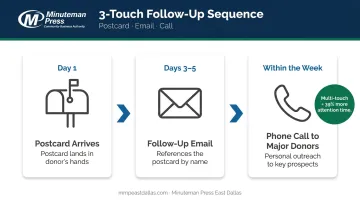
The postcard landing is the starting line, not the finish. USPS research shows that integrated campaigns hold 39% more customer attention time than digital-only efforts, and 31% of consumers are more likely to engage when receiving multiple types of communication. A multi-touch sequence drives that result.
A basic follow-up sequence:
- Postcard arrives (Day 1)
- Email sent within 3–5 days referencing "the card we sent you"
- Phone call to major donors within the week
Targeting and Personalizing Your Donor Outreach
Four Segmentation Dimensions
Effective targeting goes beyond "everyone on our list." Segment across:
- Geographic — ZIP codes, neighborhoods, proximity to your service area
- Demographic — age, household income, family status
- Behavioral — giving frequency, gift size history, lapse time
- Psychographic — cause affinity, shared values, community involvement
A concrete DFW example: a food bank might mail a different postcard to lapsed donors in Garland vs. first-time prospects in Mesquite. The lapsed donor version leads with impact proof ("Your last gift helped us serve 200 families"). The prospect version leads with the problem and mission.
Variable Data Printing: Personalization at Scale
Variable data printing (VDP) lets you change text, images, and codes from piece to piece within a single print run. For nonprofits, this means:
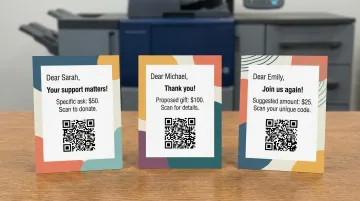
- Donor names in the headline ("Sarah, families in your community need your help")
- Personalized gift asks based on prior giving history
- Unique QR codes per recipient for precise response tracking
Research from WhatTheyThink/Keypoint Intelligence found that 97% of businesses using personalized direct mail reported higher response rates, with 56% saying rates were significantly higher. Minuteman Press East Dallas handles full VDP postcard campaigns — individualized asks, unique QR codes per recipient, all produced locally in Dallas.
Match Your Response Pathway to Your Audience
Generational preferences shape how donors want to respond:
- Baby Boomers — the most mail-responsive generation; Blackbaud data shows 40% reported giving in response to a mail appeal. Prioritize this segment for direct mail campaigns.
- Gen X and Millennials — respond well when the postcard drives them to a digital action (QR code, donation URL). USPS data shows 64% of Millennials expressed interest in using QR codes on mailpieces.
- Gen Z — 72% report excitement about discovering what the mail brings; expects a mobile-optimized donation page on the other end.
Tracking Success and Measuring ROI
The KPIs That Matter
| KPI | Formula | What It Tells You |
|---|---|---|
| Response rate | Responses ÷ pieces mailed × 100 | Overall campaign effectiveness |
| Average gift size | Total donations ÷ number of gifts | Donor generosity level |
| Cost per acquisition | Total campaign cost ÷ new donors | Acquisition efficiency |
| ROI | (Revenue − cost) ÷ cost × 100 | Return on investment |
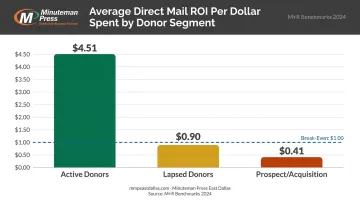
M+R Benchmarks 2024 provides useful context: active donor mailings generated average ROI of $4.51 per dollar spent, while lapsed donor mailings generated $0.90 and prospect/acquisition mailings generated $0.41. Acquisition campaigns often run at a loss initially — the value comes from adding high-quality names to your donor file.
Three Tracking Mechanisms
Every postcard should include at least one trackable response element:
- Unique QR codes — scanned in real time; best for digital-first donors and immediate attribution
- Personalized URLs or promo codes — separates campaign traffic in your analytics platform
- Dedicated phone numbers — call tracking routes and logs calls from a number printed only on that specific mailing
Testing and Improving Over Time
Test one variable at a time: headline, image, ask amount, or postcard size. Split your list into two segments, run the test, then compare response rates. Document results and apply learnings to the next campaign.
That accumulated data becomes a performance baseline specific to your donor file, which will serve you better than any generalized industry number.
Common Mistakes Nonprofits Make with Fundraising Postcards
Design Overload Kills Response Rates
Nonprofits often treat postcards like brochures — statistics, program summaries, multiple asks, upcoming events. Each additional element dilutes attention. One message, one CTA, one action pathway. That's the structure that converts.
Sending to the Wrong List Wastes Budget
Sending a retention appeal to cold prospects, or an acquisition piece to loyal long-term supporters, signals that you don't know your audience. List investment — whether cleaning internal data or sourcing targeted external lists — has a direct, measurable impact on ROI.
Minuteman Press East Dallas can build targeted lists by geography and demographics if your internal data needs supplementing.
Skipping the Follow-Up Leaves Money Behind
Most nonprofits send a postcard and wait. That approach misses significant response lift. A postcard is a campaign touch, not a standalone ask — it works best paired with email, social, and phone follow-up.
Donors who give in response to a postcard also deserve a timely, personalized thank-you — ideally in the same format they gave, or a hand-signed note for major gifts. That stewardship step is where the next gift begins.
Frequently Asked Questions
Is direct mail effective for fundraising?
Yes. JICMAIL reports 76.5% of mail is read or glanced at, versus a 28.59% average email open rate for nonprofits. M+R Benchmarks 2026 puts active donor direct mail ROI at $4.51 per dollar spent, with nonprofit direct mail revenue up 9% in 2025.
What is the 80/20 rule for fundraising?
Roughly 80% of a nonprofit's donations typically come from 20% of its donors. In practice, this means your postcard budget and personalization effort should skew toward your highest-value segment — more frequent mailings, larger formats, and personalized asks — rather than sending identical pieces to your entire list.
How much does a postcard campaign cost?
Design, printing, and postage are the main variables. Nonprofits with a USPS Marketing Mail permit pay as low as $0.155 per piece — roughly 36% less than commercial rates. Minuteman Press East Dallas can consolidate design, printing, and mailing in one order with volume pricing; call 214-660-7003 for a quote.
What size postcard is best for a fundraising campaign?
Larger postcards (6" × 9" or 6" × 11") stand out more in the mailbox and allow more room for imagery, copy, and a QR code. Standard 4" × 6" cards cost less and work well for high-volume mailings. Test both for your audience — the right answer depends on your segment and campaign goal.
How do I build a mailing list for a nonprofit postcard campaign?
Three main sources: your internal donor database (best starting point), purchased or rented lists filtered by geography, demographics, or giving behavior, and USPS Every Door Direct Mail (EDDM) for broad neighborhood-level outreach at $0.247 per piece without requiring individual name data.
Should I include a QR code on my fundraising postcard?
Yes. QR codes make it easier for digital-first donors to give, link directly to your donation page, and provide scan tracking so you can attribute responses to specific mailings. With 64% of Millennials open to using QR codes on mailpieces, they're worth including in any campaign targeting donors under 60.