This shift in consumer expectations has fundamentally changed what makes print marketing work. Businesses that send the same piece to every contact on their list aren't just getting lower results — they're actively training their audience to ignore them.
Variable Data Printing (VDP) is the technology that closes this gap. It's frequently described as a technical feature, but the real story is what it delivers: higher response rates, more efficient print budgets, and customer communications that actually land. This article covers what VDP is, why the advantages are measurable, and what businesses lose by skipping it.
Key Takeaways
- VDP customizes text, images, and design elements for every individual piece within a single print run — no duplicate pieces required
- A customer database or spreadsheet drives the personalization automatically, pulling names, offers, locations, or images into a pre-built template
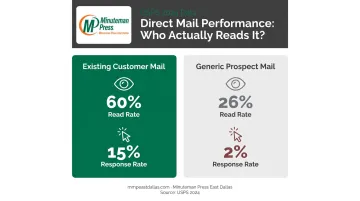
- Existing-customer direct mail achieves a 15% response rate vs. 2% for generic prospect mail — per the USPS FY 2024 Household Diary Study
- VDP eliminates multiple print runs across different customer segments
- Skipping VDP means lower engagement, wasted budget, and leaving customer data unused
What Is Variable Data Printing?
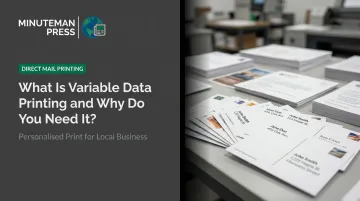
Variable Data Printing is a digital printing method where elements — names, addresses, images, offers, or copy — change automatically from one printed piece to the next within a single job. The press pulls data from a customer database or spreadsheet and populates a pre-designed template, so every piece looks custom with no manual intervention between prints. SCREEN Europe defines VDP as changing text, images, graphics, or codes from one piece to the next without interrupting the printing process — no stopping, no new plates, no separate jobs for different segments.
Where VDP Gets Used
VDP applies to any print format where tailoring the message adds value:
- Personalized postcards — names, neighborhood-specific offers, location-based imagery
- Direct mail letters — customized salutations, purchase-history references, segmented offers
- Donor appeal letters — giving history acknowledgments, personalized ask amounts
- Loyalty program mailers — tier-specific rewards and member recognition
- Targeted promotional coupons — product-relevant discounts based on past behavior
- Event invitations — personalized guest details and custom messaging
At Minuteman Press East Dallas, VDP is part of the digital printing and direct mail service offering — covering postcards, letters, and targeted promotions for businesses and nonprofits across Dallas, Garland, Mesquite, and the broader DFW area. The shop handles everything from data preparation through final delivery, so businesses don't need in-house print expertise to run a personalized campaign.
The goal is relevance. Each piece is built around the recipient's data, so it reads like it was written for them specifically — not broadcast to a list.
Key Advantages of Variable Data Printing
Advantage 1: Dramatically Higher Engagement and Response Rates
The most direct argument for VDP is the response rate gap between relevant mail and generic mail.
The USPS FY 2024 Household Diary Study put it in concrete terms: advertising mail sent to existing customers achieved a 60% read rate and 15% response rate. Mail sent to cold prospects? A 26% read rate and 2% response rate. That gap compounds across every campaign you run.
When a printed piece includes a recipient's name, reflects their purchase history, or shows imagery tied to their actual interests, it bypasses the "junk mail" reflex. It reads like communication, not broadcast.
How VDP creates this result: By pulling individual customer data — name, location, preferences, past behavior — from a CRM or spreadsheet and merging it into a template automatically, every piece carries the signal that it was made for that person. The production speed of a standard print run doesn't change. Only the output does.
KPIs this affects:
- Response rate
- Conversion rate
- Cost per acquisition
- Campaign ROI
When this matters most: Segmented direct mail lists, nonprofit donation appeals, retail promotions with purchase history data, and any campaign where you have collected meaningful customer data points. The more specific the data, the wider the performance gap becomes.
Advantage 2: Mass Personalization Without Proportional Cost Increases
Historically, businesses faced a binary choice: cheap and generic, or personalized and expensive. VDP eliminates that trade-off.
Digital printing doesn't require separate plates or press setups for each variation. Changing content from one piece to the next adds minimal cost, because the press is already running. Sending 5,000 personalized mailers is operationally comparable to sending 5,000 identical ones — the per-unit cost difference is marginal.
The production principle, confirmed by USPS, is that tailored mailpieces can print next to each other in a single run. One setup, one run, unlimited variation.
Why this matters for budgets:
Epsilon research found that 80% of consumers are more likely to make a purchase when brands offer personalized experiences. When the cost of delivering that personalization is nearly identical to generic printing, the ROI case is straightforward.
Consider the alternative: running separate print jobs for new customers, returning customers, lapsed customers, and different geographic segments. Each run carries its own setup cost and coordination overhead. VDP consolidates all of that into one job.
KPIs this affects:
- Cost per printed piece
- Print budget utilization
- Campaign waste reduction
- Number of print runs required
Best use cases: Large-volume direct mail campaigns across multiple customer segments, or when a business needs to serve different markets — different offers for new vs. returning customers — without duplicating the full design and production process.
Advantage 3: Stronger Customer Relationships and Long-Term ROI
Single-campaign performance is the obvious win. The less obvious one is what consistent VDP does to how customers perceive a brand over time.
When every printed touchpoint reflects what a customer has purchased, where they are, or what tier they've reached in a loyalty program, it sends a clear signal: this business knows me. That feeling drives repeat purchase behavior in ways generic mail simply can't replicate.
McKinsey research found that 78% of consumers said personalized content made them more likely to repurchase from a brand, and that 76% get frustrated when companies fail to deliver personalized interactions. VDP print campaigns are one of the most direct ways to meet that expectation through a physical channel.
The compounding effect: A customer who receives a relevant, personalized mailer is more likely to respond. A customer who receives consistently relevant communication over time develops a different relationship with that brand — one that's harder for competitors to displace.
VDP also connects print to measurement. When personalized pieces include QR codes or personalized URLs (PURLs), they become trackable touchpoints that feed attribution data back into future campaign decisions. Print becomes a measurable channel with real attribution data, not just a line item you hope is working.
KPIs this affects:
- Customer retention rate
- Repeat purchase rate
- Campaign tracking and attribution
- Customer lifetime value
Where you'll see the biggest impact: Businesses with established customer databases, nonprofits managing donor relationships, healthcare providers running patient communications, and retailers with repeat-purchase campaigns.
What Happens When Variable Data Printing Is Overlooked
Generic print campaigns carry a hidden cost that shows up in response rates, wasted spend, and missed connections with customers who expected more.
USPS FY 2024 data shows that 30% of advertising mail was discarded without being read, and another 22% was only glanced at. More than half of every generic mailing produces no engagement at all. For a business spending real money on print production and postage, that's a large share of the budget producing zero return.
The concrete consequences of skipping VDP:
- Lower response rates on direct mail and promotional campaigns
- Wasted spend on materials that don't resonate with segmented customer groups
- Missed opportunities to use customer data that most businesses are already collecting
- Harder time standing out when competitors are using personalization and you aren't
The frustration data reinforces this: McKinsey found 76% of consumers get frustrated when businesses don't personalize their communications. Generic print doesn't just underperform — it creates a negative brand impression with the very customers you're trying to reach.
Every generic campaign that underperforms is budget that could have worked harder. That gap compounds over time, quietly pulling down overall marketing ROI while personalized competitors gain ground.
How to Get the Most Value from Variable Data Printing
VDP works best when it starts with clean data. The quality of personalization is only as good as the information behind it. Before launching a campaign, audit your customer list: check for accuracy in names, addresses, and any variables you plan to use — outdated or misspelled data produces personalization that backfires.
Practical starting points:
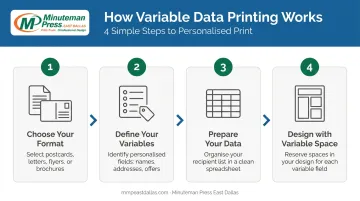
- Choose your format: postcard, direct mail letter, coupon, or targeted promotion
- Define your variables: recipient name at minimum, plus an offer or image tied to purchase history or customer segment
- Prepare your data: organize customer records in a spreadsheet with consistent column headers for each variable field
- Design with variable space in mind: build templates so fields accommodate different name lengths or offer text without breaking the layout
If managing these steps in-house feels like too much, a local print partner can handle the whole process. Minuteman Press East Dallas manages VDP campaigns end-to-end — from digital printing to mailing — for businesses across Dallas, Garland, Mesquite, and the broader DFW area. The shop works with nonprofits, schools, healthcare providers, real estate agents, and retailers, and can build a targeted mailing list if you don't have one.
Call 214-660-7003 or stop by 12640 E. NW Hwy., Suite 413, Dallas, TX 75228.
Conclusion
Variable Data Printing isn't a feature reserved for enterprise-level campaigns. Any business with a customer list can use it to make print marketing work harder — and the advantages are measurable from the first campaign.
Relevance drives engagement. Consolidating segmented campaigns into a single print run cuts costs. And personalized communication, sent consistently, builds the kind of customer relationships that compound over time.
Businesses that make VDP part of their regular print practice will outperform competitors still sending the same piece to everyone. The tools to do it exist right now, and the businesses acting on that today are the ones building loyalty tomorrow.
If you're ready to put VDP to work for your Dallas-area business, Minuteman Press East Dallas handles variable data direct mail from list to delivery — call us at 214-660-7003 to get started.
Frequently Asked Questions
What does variable data mean in printing?
"Variable data" refers to elements in a print piece that change from one copy to the next (such as a recipient's name, a personalized offer, or a relevant image), as opposed to static elements that stay the same across the entire run. The fixed design stays constant; only the data-driven fields change.
What type of printing is used to print variable data?
VDP relies on digital printing technology rather than traditional offset printing, because digital presses can update content on-the-fly between each piece without requiring new plates or stopping production. This makes real-time personalization at scale possible.
What are examples of variable data printers?
VDP is performed on high-speed digital inkjet and laser printing systems used in commercial print shops, such as HP Indigo presses paired with tools like HP SmartStream Designer or Xerox XMPie. The data-merge software does just as much work as the press itself.
What is the difference between variable data printing and regular printing?
Regular offset printing produces identical copies of the same design. VDP produces individually customized pieces within the same run. Regular printing suits large-volume, uniform materials like brochures; VDP is built for personalized campaigns where relevance drives results.
Is variable data printing more expensive than standard printing?
VDP carries a slightly higher cost per piece than standard digital printing, but higher response rates and conversion performance typically more than offset it. What matters is your cost per result, not cost per piece — and personalized campaigns consistently deliver better returns on that measure.
What industries use variable data printing most?
Retail (personalized coupons and offers), nonprofits (donor appeals), healthcare (patient reminders), real estate (neighborhood-specific mailers), and financial services all use VDP heavily. Any industry that communicates directly with a known customer or prospect base can benefit from it.