Introduction
Picture this: a Dallas restaurant owner spending hours managing Facebook ads, tweaking email subject lines, and posting to Instagram — only to have a neighbor walk in waving a postcard and say, "I saw this in my mailbox and had to come check you out."
That's postcard marketing in action. And despite being one of the oldest tools in the direct mail playbook, it's having a genuine moment.
According to the USPS Household Diary Study, 76% of households read or scan advertising mail (a benchmark figure that has held consistent across subsequent USPS tracking) — meaning your postcard is far more likely to be seen than most digital touchpoints that fight for the same attention.
This guide gives Dallas-area small businesses a practical roadmap for postcard campaigns that actually convert: from planning and design to audience targeting and tracking results.
Key Takeaways
- Postcard marketing is a direct mail strategy that works across multiple business goals — new customer acquisition, reactivation, promotions, and local awareness
- Physical mail cuts through digital noise; 76% of households read or scan advertising mail (USPS Household Diary Study)
- Effective campaigns require a clear goal, targeted list, strong offer, and trackable CTA
- EDDM lets hyper-local businesses reach entire Dallas neighborhoods without buying an address list
- Working with a single vendor for design, print, and mailing saves time and keeps your campaign on schedule
What Is Postcard Marketing and Why Does It Still Work?
Postcard marketing is a direct mail strategy where businesses send branded, physical postcards to a targeted audience. Goals vary — promoting a service, reactivating lapsed customers, driving traffic to a landing page. Delivery happens through USPS mailings, event handouts, or package inserts.
The "isn't this outdated?" objection comes up often. The answer is no — and the reason is straightforward: digital overload has made physical mail more valuable, not less.
The average professional receives dozens of emails daily. Most go unread or deleted. A postcard doesn't compete with that noise because it lives in a completely different channel. It arrives in the physical mailbox, requires no login, and can't be filtered into spam.
Research from Canada Post's neuromarketing study found that direct mail produces 70% higher brand recall than digital media and requires 21% less cognitive effort to process. That combination — higher memorability with less effort — is hard to replicate online.
What Can a Postcard Campaign Accomplish?
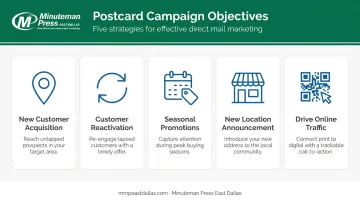
Postcards work across a wide range of business objectives:
- Reach cold prospects by zip code, neighborhood, or demographics to acquire new customers
- Reconnect with people who haven't purchased recently through a reactivation offer
- Run time-sensitive seasonal deals with a clear expiration date
- Announce a new location or service in a way that feels tangible and direct
- Send recipients to a landing page, promo code, or QR scan to drive online traffic
Key Benefits of Postcard Marketing for Local Businesses
High Visibility From the Moment It Lands
Unlike email, postcards require no envelope to open. The message is visible the instant someone picks up their mail. That built-in visibility is something digital channels can't replicate — there's no inbox filter, no algorithm, no unopened notification standing between the message and the reader.
JICMAIL data from UK joint-industry mail research found that direct mail is retained an average of 7.92 days per household and receives 4.23 interactions during that time — meaning one postcard can generate multiple impressions across multiple household members.
Strong Response Rates
Direct mail consistently outperforms email in response rate. According to the ANA's 2022 postcard-specific data, postcards to house lists produced a 92% ROI — a figure that holds up well against most digital advertising channels for local businesses.
Tangibility Builds Trust
Holding a well-printed postcard creates a sensory experience a scrolled-past social ad can't match. Weight, paper texture, and finish all communicate quality before a single word is read. Postcards printed on heavier stock — 14pt coated card or 16pt — tend to stay on desks and bulletin boards far longer than flimsy alternatives, extending the impression window well beyond the initial delivery.
Personalization and Targeting
That physical staying power pairs well with another advantage: modern postcards don't have to be generic. Variable data printing (VDP) allows each card to be personalized by:
- Recipient name
- Geographic area or neighborhood
- Past purchase behavior
- Personalized URL (pURL) unique to each recipient
Minuteman Press East Dallas offers VDP as part of its postcard printing services, so a single print run can reach hundreds of recipients with messaging tailored to each one — rather than a one-size-fits-all blast.
Works With Your Digital Marketing
Postcards don't replace digital channels — they amplify them. A postcard landing in someone's mailbox can prompt them to respond to an email they previously ignored, visit a landing page, or scan a QR code to claim an offer. Combined campaigns drive 39% more attention and 40% higher brand recall than single-media digital campaigns, according to Canada Post research.
How to Plan an Effective Postcard Marketing Campaign
Every successful postcard campaign follows the same basic structure: a clear goal, the right audience, a compelling offer, and the logistics to back it up. Here's how to work through each piece.
Step 1 — Set a Clear Campaign Goal
Before a single design element is chosen, define the specific outcome you want. Examples:
- Generate X new leads from a specific zip code
- Win back customers who haven't visited in 6+ months
- Drive foot traffic during a limited-time sale
- Announce a grand opening to nearby residents
The goal shapes your list, your offer, your CTA, and how you measure success.
Step 2 — Know Your Audience and Build Your List
Who receives your postcard determines whether the campaign works. Options include:
- House list — your existing customers; highest response rates because they already know your brand
- Purchased/targeted prospect list — filtered by zip code, demographics, homeowner status, income, etc.
- EDDM routes — saturation mailing to every address on selected carrier routes
Sending to a poorly matched list wastes money regardless of how good the design is. Audience quality matters as much as quantity.
Step 3 — Develop an Offer That Motivates Action
Postcards perform best with a clear, compelling offer. Focus on what the recipient gains, not what you're selling:
- A discount or time-limited deal
- A free consultation or estimate
- An exclusive event invite
- A bonus for first-time customers
"We've been serving Dallas since 2004" is not an offer. "Get 20% off your first order — expires [date]" is.
Step 4 — Choose the Right Postcard Size
USPS classifies postcards by size, and the classification affects both postage and visual impact:
| Size | Notes |
|---|---|
| 3" x 5" or 4" x 6" | Qualifies for First-Class postcard postage ($0.61 retail / $0.42+ commercial, check USPS for current rates) |
| 5" x 7", 5.5" x 8.5" | Larger format; may be classified as a flat or letter — check USPS DMM |
| 6" x 9", 6" x 11" | Maximum visual impact; higher postage cost |
Minuteman Press East Dallas offers all six of these standard sizes. Larger formats stand out in a mailbox; smaller ones keep postage costs lower. If your offer is simple and your list is large, a 4" x 6" keeps costs manageable. If you're targeting a smaller, high-value audience, a 6" x 9" or 6" x 11" makes a stronger first impression.
Step 5 — Set a Budget and Timeline
Key cost components to plan for:
- Design (professional or in-house)
- Printing (quantity, size, paper stock, finishes)
- Mailing list (house list vs. purchased)
- Postage (varies by size, class, and sortation)
Timeline matters too. Factor in design revisions, print production, list preparation, and USPS delivery windows. Starting the planning process at least 3–4 weeks before your target in-home date is a safe standard for most campaigns. With those five elements locked in, you're ready to move into design and execution.
Postcard Design and Print Best Practices
Lead With One Strong Message
Postcards have about three seconds to grab attention. The front of the card should do one job: make someone stop and read. That means:
- A dominant, high-quality image
- A headline that communicates the core value immediately
- Minimal body copy — simplicity wins
Resist the urge to pack in every feature, phone number, and service description. The goal is to generate a response, not deliver a brochure.
Make the CTA Impossible to Miss
Every postcard needs exactly one call to action — and it should be prominent in both size and placement. Strong CTAs are specific:
- "Call by [date] to claim your discount"
- "Scan the QR code to book your free estimate"
- "Visit [URL] and use code DALLAS20"
Adding a trackable element (QR code, promo code, or personalized URL) also lets you measure which recipients responded — which is essential for calculating ROI.
Use Design Elements With Purpose
Good postcard design isn't decoration — it directs the reader's eye. Key principles:
- Use contrast to pull the eye toward headlines and CTAs
- Give white space room to breathe — it improves readability and reduces visual noise
- Establish font hierarchy so headline, offer, and contact info read in the right order
Premium finishes — gloss or matte lamination, UV coating, foil accents — can signal higher quality and make a card feel worth keeping. Minuteman Press East Dallas offers laminating, foil stamping, and die-cutting as finishing options for postcards.
Don't Waste the Back of the Card
The back is prime real estate. Use it for:
- Offer details and fine print
- Business name, address, and phone number
- Return address (required for USPS delivery)
- Tracking elements (QR code, promo code, pURL)
A cluttered back undermines a strong front. Keep it organized with clear visual hierarchy.
Work With a Professional Print Partner
Print quality signals brand quality. A thin, blurry card communicates something — just not what you want. For Dallas-area businesses, Minuteman Press East Dallas handles full-color commercial postcard printing in a range of sizes and paper stocks (including 14pt and 16pt coated card), along with finishing options and full mailing services. Having design, print, and mailing handled in one place keeps your timeline tight and your campaign on track.
Building Your Mailing List and Targeting the Right Audience
House Lists vs. Purchased Lists
| List Type | Best For | Response Rate |
|---|---|---|
| House list (existing customers) | Reactivation, loyalty offers, cross-sell | Higher — recipients know your brand |
| Purchased/rented prospect list | New customer acquisition | Lower, but scalable |
Owned lists almost always outperform purchased ones because the relationship already exists. If you have a customer database, use it first.
Once you've worked your house list, EDDM is the most practical way to expand your reach into new local households.
Every Door Direct Mail (EDDM) for Hyper-Local Reach
EDDM is a USPS program that lets businesses mail to every household on selected carrier routes without needing individual addresses. Key facts:
- Current EDDM Retail postage rate: $0.247 per piece (effective April 26, 2026)
- Minimum 200 pieces; maximum 5,000 pieces per day per zip code
- You can filter by zip code and use Census data to target by age, income, or household size
For Dallas neighborhood businesses — restaurants, home service providers, medical offices, retail shops — EDDM is one of the most cost-efficient ways to reach nearby residents. Minuteman Press East Dallas handles the full process, from carrier route selection and list targeting to printing and USPS submission.
Whether you're using EDDM or a custom list, the quality of that list determines how far your budget goes.
List Hygiene and Segmentation
Every piece of returned mail is postage you paid for nothing. Keeping your list clean is one of the easiest ways to protect your campaign budget. Best practices:
- Update your house list regularly to remove outdated addresses
- Suppress recent non-responders from reactivation campaigns
- Segment by purchase history, geography, or customer type for more relevant messaging
How to Track and Measure Your Postcard Campaign
Build Tracking Into the Design From the Start
Tracking shouldn't be an afterthought. Plan these elements during the design phase:
- Unique promo codes — a specific code tied to the mailing so redemptions can be traced
- Dedicated landing pages / pURLs — a URL only this campaign uses; traffic there = postcard responses
- Trackable phone numbers — a unique number that forwards to your main line but logs calls separately
Each method connects responses back to the postcard without guessing.
Metrics That Matter
| Metric | How to Calculate |
|---|---|
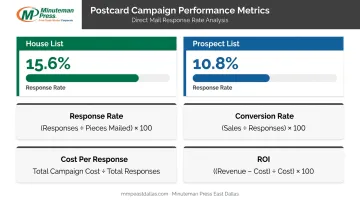
| Response rate | Responses ÷ total pieces delivered |
| Conversion rate | Conversions ÷ total responses |
| Cost per response | Total campaign cost ÷ number of responses |
| ROI | (Revenue generated − campaign cost) ÷ campaign cost |
For context, the ANA's 2023 data reports direct mail response rates of 15.6% for house lists and 10.8% for prospect lists. These figures vary by industry and offer quality — use them as a starting benchmark, not a guarantee.
Use Results to Improve the Next Mailing
Every campaign produces data. After it wraps, review:
- Which list segment had the best response rate?
- Did the offer drive conversions, or just inquiries?
- Which postcard size or design variant performed better?
A/B testing different offers, sizes, or headlines across list segments is a practical way to raise performance with each subsequent mailing. The data from one mailing directly informs what to test — and improve — in the next.
Frequently Asked Questions
What is a postcard marketing campaign?
A postcard marketing campaign is a direct mail strategy where businesses send printed, branded postcards to a targeted audience to promote an offer, generate leads, or build local awareness. Delivery can happen through USPS mailings, in-person handouts, or as package inserts.
Does postcard marketing still work?
Yes, and the rise of digital noise has actually made it more effective. Physical mail bypasses the inbox entirely, and direct mail consistently outperforms email in response rates. It works best when paired with a compelling offer and a well-matched mailing list.
How much does a postcard marketing campaign cost?
Costs vary by quantity, postcard size, paper stock, finish options, and postage class. USPS First-Class postcard postage runs $0.61 per piece; EDDM Retail runs $0.247 per piece (rates effective April 26, 2026). For an all-in quote on design, printing, and mailing, contact Minuteman Press East Dallas at 214-660-7003.
What should I include on a marketing postcard?
Every postcard needs a compelling headline, a strong visual, a clear offer or value proposition, a single call to action, and your business contact information. Add a trackable element — QR code, promo code, or personalized URL — so you can measure responses.
How do I track the results of a postcard campaign?
The three main methods are unique promo codes, dedicated landing pages or personalized URLs (pURLs), and unique phone numbers. Each ties responses directly back to the mailing, giving you real data on response rates and ROI.