Postcard marketing is one of the most underutilized channels in the automotive industry, despite being uniquely suited to it. Car owners have predictable service needs — oil changes, tire rotations, seasonal inspections — and a timely physical reminder is both relevant and actionable.
This guide covers everything an auto business needs to run a successful postcard campaign: targeting the right households, designing cards that get responses, crafting offers that convert, and measuring what works. Whether you run a repair shop in Garland, a tire store in Mesquite, or a multi-service dealership in Dallas, these principles apply directly.
Key Takeaways
- Physical mail gets read far more often than email — postcards reach customers without fighting inbox clutter
- Target by geography (EDDM) for broad awareness or by vehicle type and demographics for specialty services
- One clear offer, one strong visual, one call to action: cluttered postcards get discarded
- Seasonal campaigns (summer AC checks, pre-winter prep) map directly to Texas automotive demand cycles
- Track every campaign with unique promo codes or QR codes before the first card mails
Why Postcard Marketing Still Works for Auto Shops
The most straightforward argument for postcards: mailboxes are far less crowded than inboxes. According to the USPS Household Diary Study FY 2022, U.S. households received an average of 15.4 pieces of mail per week — compared to dozens or hundreds of emails daily. Less competition means more attention.
Physical Mail Earns Trust
There's a credibility difference between a physical card and a banner ad. USPS-commissioned Temple University neuromarketing research found that physical ads created stronger memory effects than digital ads across age groups. For service businesses where trust is the deciding factor — especially auto repair — that matters.
ASE's 2022 survey of nearly 1,500 vehicle owners found that 41% said certifications factored into their shop selection, and after a brief explanation of ASE credentials, 77% said that knowledge would influence future facility choices. Trust signals work — and postcards give you space to show them.
Postcards Complement Digital, Not Replace It
The argument against postcards often sounds like: "We already do digital." That's a reason to add postcards, not skip them. A Canada Post/Ipsos neuromarketing study found that integrated direct mail plus digital campaigns generated 39% more attention and 10% higher brand recall than digital-only campaigns.
When a customer sees your Google ad and then finds your postcard in the mailbox, that repetition builds confidence and pushes them to book.
The automotive industry has a natural advantage here. These services recur on predictable schedules:
- Oil changes (every 3,000–5,000 miles)
- Tire rotations (every 6,000–8,000 miles)
- Seasonal checks (pre-winter, pre-summer)
Postcards timed to those intervals aren't just advertising. They're useful reminders that arrive when service is already due.
Targeting the Right Audience for Your Automotive Postcards
Two main approaches exist, and choosing between them depends on your shop type and goals.
EDDM vs. Targeted Mailing Lists
| Approach | Best For | Cost |
|---|---|---|
| EDDM (Every Door Direct Mail) | Building neighborhood awareness, quick-lube shops, general repair | From $0.247/piece — no list purchase required |
| Targeted mailing lists | European car specialists, diesel shops, high-income demographics | Higher per-piece cost, but reaches qualified prospects |
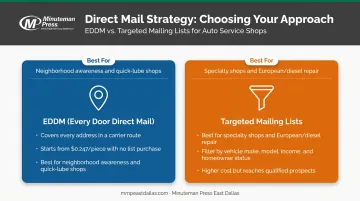
EDDM blankets every address in a carrier route or ZIP code. It's the right choice when you want to dominate a local radius — say, all households within five miles of your shop in East Dallas or Garland. No address list needed; just select your routes and mail.
Targeted lists let you filter by vehicle make, model, year, income, homeowner status, and more. Data Axle's automotive database pulls from over 185 million vehicle purchase and registration records, making it possible to reach every BMW or Mercedes owner in Mesquite within a specific income bracket.
Keep Your House List Clean
If you're mailing to existing customers, list hygiene matters more than most shop owners realize. 11.8% of U.S. households moved in 2024 according to Census ACS data — meaning roughly 1 in 8 addresses on a year-old list may already be wrong.
USPS NCOALink maintains approximately 160 million permanent change-of-address records. Processing your list against it before each campaign prevents wasted postage and ensures you're actually reaching the customers you paid to reach.
Build a Lookalike Audience
Look at your most profitable existing customers and build a prospect list around them. Key profile attributes to match:
- Location relative to your shop (service radius)
- Vehicle make, model, and year
- Household income bracket
- Homeowner status
Buying a list of prospects who match that profile typically generates higher response rates than broad geographic saturation — especially for specialty shops where the right vehicle owner matters more than sheer volume.
Designing Automotive Postcards That Convert
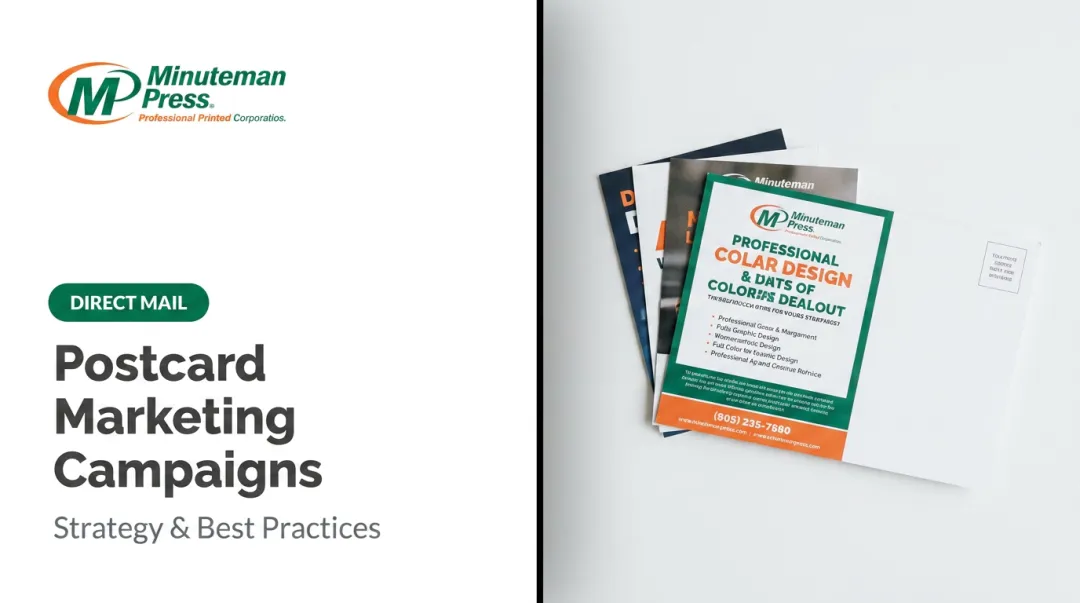
The single most common mistake in postcard design: trying to say too much. One offer, one dominant image, one call to action. Cards that communicate in three seconds get kept; cards that require reading get recycled.
Essential Elements Every Card Needs
- Bold headline — lead with the offer or service, not your shop name
- High-quality vehicle or shop imagery — clean, professional photography
- Bullet-pointed service highlights — three to four benefits, scannable
- Prominent contact details — phone number, website, address in readable type
- QR code — links to an online booking page or dedicated offer landing page
- Trust signals — Google star rating, ASE certification logo, years in business
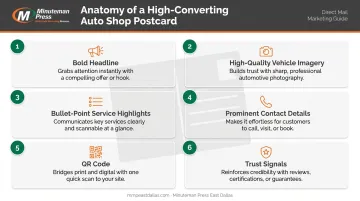
The trust signals item is worth calling out specifically. 77% of surveyed vehicle owners say ASE certification knowledge would influence their future shop selection — displaying that credential directly on the card is a genuine conversion driver, not a nice-to-have.
Size and Stock Matter
Oversized formats stand out in a stack of mail. Minuteman Press East Dallas offers postcards in 6×9 and 6×11 formats alongside standard sizes — these larger cards catch attention before the recipient decides whether to read them. For USPS Marketing Mail, cards up to 6-1/8 × 11-1/2 inches qualify without moving into flats pricing.
For card stock, 14pt C2S (Coated 2 Sides) provides a professional finish that holds up through mail handling without feeling cheap. The glossy surface makes vehicle photography and brand colors pop — a real advantage when you're competing for visibility in a crowded mailbox.
Minuteman Press East Dallas handles design, print, and mailing end-to-end using USPS-approved software. They serve auto businesses throughout Dallas, Garland, Mesquite, and the broader DFW area, and can guide your card selection based on campaign goals and budget.
What Offers and Messaging Drive the Most Response
Vague copy kills response rates. "Quality service you can trust" is forgettable. "$29.99 oil change special, expires August 31" is actionable.
Offer Types That Work for Automotive Postcards
- New customer oil change discount: low barrier to a first visit, easy to redeem
- Seasonal safety checks for AC and cooling systems before Texas summers hit
- Free tire rotation with purchase, tied to the 5,000–7,500 mile interval AAA recommends
- No-cost first-visit brake inspection to build trust before a customer commits
- Loyalty return offer that gives existing customers a reason to come back instead of trying a competitor
Every offer needs four things: a specific dollar amount or percentage, a named service, an expiration date, and one clear call to action. Those four elements are what make someone pick up the phone instead of recycling the card.
That specificity also ties directly to timing — which is where seasonal campaigns earn their keep.
Align Offers to Texas Seasonal Triggers
The automotive service calendar has natural peaks — and in Dallas-Fort Worth, summer is the biggest one. AAA Texas reported rescuing over 360,000 motorists during a single Texas summer, with triple-digit heat pushing batteries, cooling systems, and tires past their limits.
Mail AC and cooling system offers in late April or early May — before summer arrives, while customers are still planning. Pre-winter battery and tire campaigns should go out in October. Back-to-school vehicle checks work well in late July targeting families with teen drivers. Matching your offer to the season your customers are already thinking about turns the card into a timely reminder instead of junk mail.
Timing, Frequency, and Measuring ROI
When and How Often to Mail
Consistency beats perfection. A single well-designed postcard rarely produces lasting results; a campaign mailed quarterly to the same audience builds name recognition that compounds over time.
Practical timing guidelines:
- Service reminders — mail before the customer's expected service window, aligned to oil-change intervals (now often 7,500–10,000 miles or 6–12 months per Consumer Reports)
- Seasonal campaigns — 2–3 weeks before the season begins, not during it
- New customer sequences — a series of 2–3 cards over 6–8 weeks to a new prospect list keeps your shop's name in front of prospects with each card
- Post-visit follow-up — a thank-you card with a return offer sent after a first visit helps convert one-time customers into regulars
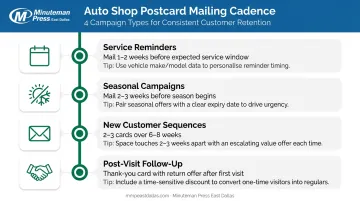
For oil-change or quick-lube shops, monthly campaigns make sense. For full-service repair shops, quarterly is a reasonable minimum.
How to Track What Each Campaign Actually Generates
Knowing your mailing cadence is only half the equation — the other half is knowing what each campaign produced.
Set up attribution before the first card ships. Assign a unique phone number or promo code exclusively to each campaign — this is how you know which mailing drove which calls. QR codes linked to a campaign-specific landing page capture digital conversions from physical mail.
According to ANA's 2023 Response Rate Report, 82% of direct mail marketers used online tracking such as QR codes or specific URLs to measure response. Most shops have access to these tools — the ones that see the clearest ROI are simply the ones that configure tracking before the first card goes out, not after.
Key metrics to track:
- Response rate (calls or bookings per cards mailed)
- Cost per appointment generated
- Total revenue from postcard-attributed visits
- Repeat visit rate from postcard-attributed customers
Once you have two or three campaigns of data, patterns emerge — which offers performed, which timing windows drove more calls, which neighborhoods responded best. At that point, you're not guessing at what works — you're optimizing based on your own customers' actual behavior.
Frequently Asked Questions
Does postcard marketing still work?
Yes. Physical mail consistently achieves higher read and response rates than email for local service businesses. The automotive industry's recurring service model (customers need maintenance on predictable schedules) makes postcards particularly effective as timed reminders rather than cold advertising.
How much do marketing postcards cost?
Costs vary by quantity, size, paper stock, and postage method. EDDM postage runs $0.247 per piece; First-Class retail postcards are currently $0.61 (with a proposed increase to $0.65 effective July 12, 2026). Printing costs decrease at higher volumes — contact Minuteman Press East Dallas at 214-660-7003 for a custom DFW quote.
What size postcards work best for automotive marketing?
Oversized formats like 6×9 or 6×11 stand out in a mailbox and give more room for imagery, offers, and contact information without looking cluttered. Minuteman Press East Dallas offers both sizes along with standard options to match your budget and campaign goals.
How often should auto shops mail postcards to customers?
Quarterly at minimum to maintain visibility; monthly works well for oil-change and quick-service shops. A consistent schedule over time builds recognition that no single large campaign can replicate.
What offers work best on automotive marketing postcards?
Specific, service-tied discounts such as oil change specials, seasonal tire checks, brake inspections, or first-visit discounts outperform generic promotions. Offers with a clear dollar amount and expiration date consistently generate stronger response than open-ended messaging.
Should I use EDDM or a targeted mailing list?
EDDM suits shops building broad local awareness at lower cost, covering every address in a defined route. Targeted lists work better for specialty shops (European car repair, diesel service) or businesses wanting to reach specific vehicle owners or income brackets within their service radius.