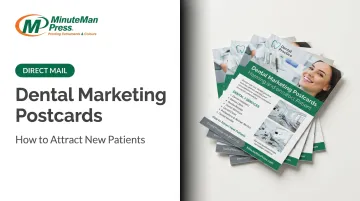
Physical postcards remain one of the most underused tools for patient acquisition. They land directly in the hands of households in your target area, bypassing crowded inboxes entirely. But results vary dramatically. Two practices can mail the same neighborhood and see completely different outcomes — because postcard marketing isn't about sending mail, it's about executing well.
This guide covers how to build a campaign that actually works: the right targeting approach, what goes on the card, which offers convert, and how to measure what you're spending.
Key Takeaways
- Dental postcards cut through digital noise with a physical mail piece — results depend entirely on how well you execute
- Success depends on four things: the right audience, a compelling offer, strong design, and consistent mailing frequency
- EDDM reaches every household on a postal route cheaply; demographic lists allow more precise targeting by income, age, and proximity
- Track ROI with a unique phone number, promo code, or dedicated landing page — otherwise you're guessing at results
- Postcards perform best as part of an ongoing, multi-drop campaign — not a single mailing
How to Launch a Dental Marketing Postcard Campaign
Many dental practices mail one batch of postcards, see modest response, and decide it doesn't work. Usually, the problem isn't the medium — it's incomplete execution. The four-stage process below is what produces consistent results.
Step 1: Define Your Goal and Target Audience
Your campaign objective shapes every other decision. Are you trying to:
- Acquire net-new patients in a specific neighborhood?
- Re-engage patients who haven't visited in 12+ months?
- Promote a specific service like Invisalign, whitening, or implants?
Each goal calls for a different message and a different list.
Two main targeting methods are worth knowing:
| Method | Best For | How It Works |
|---|---|---|
| EDDM (Every Door Direct Mail) | New practice launches, neighborhood saturation | Mails every address on a USPS carrier route — no list required |
| Demographic mailing lists | Targeting specific patient profiles | Filtered by income, age, household size, proximity to practice |
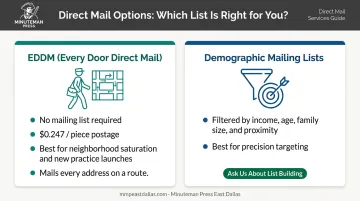
USPS EDDM lets you select routes using Census-based age, income, and household-size filters. EDDM Retail requires no bulk mailing permit, with postage as low as $0.247 per piece. USPS notes, though, that EDDM isn't suited for campaigns needing specific demographics or personalization.
For practices targeting families with children or households above a certain income threshold, a curated list from a provider like USADATA delivers more precision. These lists filter by income, insurance patterns, family composition, and geography.
Step 2: Design a Postcard That Stops the Scroll
The front of your postcard has roughly one second to earn attention in a stack of mail. That means:
- One bold visual — a real photo of your team or office, not generic stock art
- One dominant headline that states a clear benefit or offer
- Minimal text — if it needs to be read carefully, it won't be
The back should work harder:
- Brief copy addressing common patient hesitations (pain-free experience, insurance accepted, flexible scheduling)
- A single, strong call to action — "Book online" or "Call for a free exam"
- Practice name, phone number, and website
- A QR code linking to a dedicated booking page — this alone improves response tracking significantly
- A Google review count or one short patient quote for credibility
Step 3: Choose the Right Offer
Offers are the engine of postcard conversion. A well-designed card with a weak offer still underperforms.
High-converting offers for dental postcards:
- New patient bundle (exam + cleaning + X-rays at a set price)
- Complimentary consultation for a specific service (implants, orthodontics)
- In-house membership plan highlights for uninsured patients
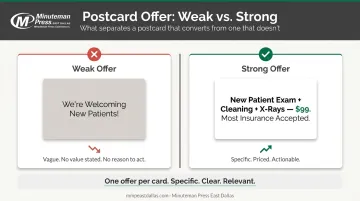
The offer doesn't have to be deeply discounted — it needs to be specific, clear, and relevant. "We're welcoming new patients!" is not an offer. "New patient exam, cleaning, and X-rays — $99" is. Multiple offers on one card dilute each other; pick one and commit.
Step 4: Print, Mail, and Set a Frequency Schedule
Direct mail rewards repetition. A single drop is a test, not a campaign. Most households need to see your practice name multiple times before they act, so plan for at least several drops spaced 3–4 weeks apart before evaluating results.
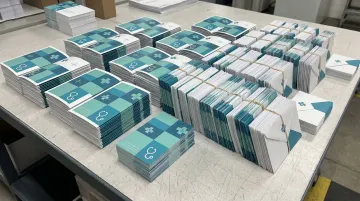
Working with a local print and mail partner who handles design, printing, and mailing in one workflow eliminates handoff errors and keeps quality consistent across drops. Minuteman Press East Dallas manages dental postcard campaigns from concept through delivery, including EDDM and custom list mailings, using USPS-approved software to keep postage costs down. When you're running multiple drops over several months, that single point of accountability makes a real difference.
When Dental Postcard Marketing Makes the Most Sense
Postcards deliver the highest return in specific situations:
- New practice launch — build brand awareness within a defined radius before your online reputation is established
- New residential development nearby — recent movers are actively shopping for local services, including a dentist
- High-value service promotions — a focused implant or clear aligner campaign with a concrete offer attached converts better in print than email
- Re-engaging lapsed patients — a physical reminder outperforms a digital nudge for patients who haven't visited in 12+ months
Where postcards are less efficient on their own:
- Heavily saturated markets where several practices are already mailing the same routes
- Practices with no defined offer to anchor the mailer
- Campaigns targeting patients outside a realistic drive-time radius
In these cases, postcards work best paired with digital retargeting — so the same household sees your practice online shortly after the card lands in their mailbox.
Key Variables That Determine Your Postcard's Success
Two practices can run nearly identical campaigns and see completely different results. The difference comes down to how well they controlled these four variables.
Headline and Offer Clarity
The headline is the single most important element on any direct mail piece. It must state a specific benefit in plain language — not clever wordplay.
Compare these:
- ❌ "Smiles That Last a Lifetime"
- ✅ "New Patient Exam + Cleaning + X-Rays — $99. Most Insurance Accepted."
Headlines that reference a real patient concern — cost, anxiety, insurance gaps — consistently outperform generic welcome messages. Where possible, add a time-bound element ("This month only," "Offer expires [date]") to create urgency without feeling gimmicky.
Audience Precision
Mailing to the right households matters more than mailing to more households. Key filters for dental practices:
- Proximity — within a defined radius of your location
- Household income — aligned with your service mix and fee structure
- Life stage — families with children for practices offering pediatric-friendly services
USADATA's dental vertical specifically filters audiences by household income, insurance coverage patterns, family composition, age, and geography — making it a practical resource for building precise lists.
Visual Quality and Postcard Size
Larger postcards stand out more in a mail stack. Minuteman Press East Dallas offers sizes from 4×6 up through 6×9 and 6×11, and the larger formats give you room for better visuals and cleaner layout.
Larger sizes do cost more to print and mail. Standard retail postcard stamps start at $0.61, while oversized pieces requiring letter-rate postage start at $0.78. For EDDM campaigns, the flat rate of $0.247 per piece applies regardless of size within EDDM's dimension requirements, making EDDM an efficient option for larger formats.
Paper stock matters too. 14pt coated stock (C1S or C2S — coated one side or two sides) prints colors sharply and holds up in the mail; lightweight or uncoated stock can feel cheap and reflect poorly on the practice.
Mailing Frequency and Consistency
USPS health sector research found that 84% of health companies check direct mail effectiveness either always or most of the time — which reflects how seriously the healthcare industry treats this channel. That attention is warranted: the same research reports that most health businesses see direct-mail response rates of 11% to 15%.
Those results depend on sustained effort. One drop gives you little data and less recognition. Multiple drops to the same households build familiarity, and familiarity converts.
Common Mistakes That Kill Dental Postcard Campaigns
Mailing Once and Giving Up
Mailing once is a test, not a campaign. Recognition builds over multiple exposures — practices that mail once, see a modest result, and stop have spent money on setup and production without any of the payoff that consistency creates.
No Tracking Mechanism
Without a unique phone number, dedicated landing page, or promo code on the postcard, there's no way to connect new patients to the campaign. Call tracking services assign a specific number to your postcard — calls to that number are logged as postcard-driven, giving you accurate attribution. Without it, you're guessing.
Weak Offer Combined With Cluttered Design
These two problems often appear together. A postcard packed with multiple offers, long paragraphs, and small print gives the reader no clear place to focus — and no reason to act. One offer, prominently stated with a clear next step, consistently outperforms the cluttered alternative.
How to Measure ROI on Your Dental Postcard Campaign
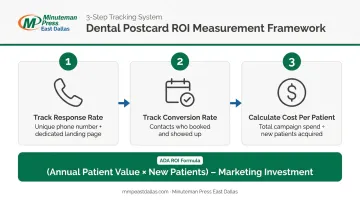
Track three numbers for every campaign:
- Response rate: contacts generated per postcard mailed (tracked via unique phone number or landing page visits)
- Conversion rate — how many contacts actually booked and showed up
- Cost per acquired patient : divide total campaign spend by the number of new patients gained
The ADA's ROI framework uses a straightforward formula: (Annual patient value × new patients acquired) − marketing investment. That calculation requires knowing your average patient value — which varies by practice but determines whether a campaign is actually profitable.
For cleaner measurement:
- Direct postcard recipients to a specific URL (not your homepage) — this isolates postcard-driven web traffic from all other sources
- Use a unique phone number that only appears on the postcard
- After 2–3 drops, compare which offer, design, or target geography produced the best response and adjust from there
ANA research reported that direct mail overall generated 112% ROI in 2022, with postcards producing the best ROI to house lists at 92%. Those figures are cross-industry averages, not dental-specific — but they explain why practices that test the channel once tend to keep it in their annual marketing budget.
Frequently Asked Questions
Does postcard marketing still work for dental practices?
It does — 68% of health businesses report direct mail is effective, and health companies are among the most likely to report response rates above 25%. Physical mail stands out in a way that email doesn't, with response rates of 11–15% typical for health-sector campaigns. Consistent frequency and a specific offer are what drive those results.
How many postcards should a dental practice mail at once?
USPS EDDM Retail allows between 200 and 5,000 pieces per day per ZIP code, which gives small practices a practical operational range. Volume is less important than sustaining it — spreading your budget across multiple drops to the same households outperforms a single large mailing every time.
What should a dental marketing postcard include?
Every effective dental postcard needs:
- A bold visual and headline with one specific offer
- Brief copy addressing cost, insurance, and convenience
- A strong call to action
- Practice contact info
- A trackable phone number or QR code linking to a booking page
How do I target the right households for my dental postcards?
EDDM covers every address on a postal route without requiring a purchased list — ideal for broad neighborhood awareness. Demographic mailing lists, available through providers like USADATA, let you filter by income, age, family composition, and proximity to your practice for more precise targeting.
How do I measure the ROI of my dental postcard campaign?
Assign a unique phone number and dedicated landing page to the postcard, then track contacts, booked appointments, and total campaign cost to calculate cost-per-patient acquired. Compare that figure against your average patient's annual value to assess return.
What postcard size works best for dental marketing?
Larger formats — 6×9 or 6×11 inches — stand out more in a mail stack and give you more design room; Minuteman Press East Dallas prints both on coated stock. The cost trade-off: oversized pieces use letter-rate postage ($0.78+) under First-Class Mail, but EDDM's flat rate of $0.247 per piece applies for route-saturation campaigns within EDDM's size guidelines.