For small business owners across Dallas, Garland, and Mesquite, digital advertising has become both expensive and unpredictable. Smart brands are responding by adding a channel that doesn't rely on algorithms, cookies, or someone's attention span at 11pm — physical mail that lands in real hands.
This guide covers exactly how they do it: building targeted lists, designing pieces that convert cold prospects, pairing mail with digital, and measuring every dollar spent.
Key Takeaways
- Direct mail reaches cold prospects that digital channels simply can't touch
- Targeted lists — demographic, geographic, or EDDM — drive response rates that outperform most digital formats
- Print quality and personalization are trust signals, not luxuries
- Pairing mail with digital follow-up multiplies campaign effectiveness
- ROI is measurable when tracking is built into the piece before it prints
Why Direct Mail Still Works for Customer Acquisition
The Numbers Make the Case
The skeptic's argument against direct mail usually goes: "Nobody reads that stuff anymore." The data disagrees.
According to the ANA Response Rate Report 2023, direct mail to prospect lists achieves a 10.8% response rate with 33.7% ROI — and house lists perform even stronger at 15.6% response rate and 160.9% ROI. For comparison, the same report puts digital display ROI at 23% with a $60.35 cost per acquisition.
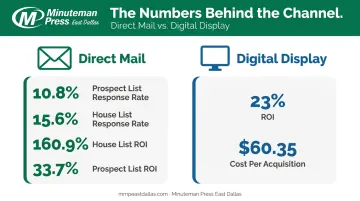
These are real conversions from cold audiences — not warmed-up retargeting pools.
The Digital Fatigue Factor
The average American encounters between 4,000 and 10,000 advertisements in a single day. Banner ads, pre-roll video, sponsored posts, push notifications — it's all blurring together. Physical mail occupies a different cognitive space entirely — it can't be blocked, skipped, or scrolled past.
There's neuroscience behind this, not just intuition. A Canada Post study using EEG and eye-tracking with 270 participants found that direct mail required 21% less cognitive effort than digital media, produced 20% higher motivation response, and generated 75% brand recall versus 44% for digital formats.
Top-of-Funnel Reach Digital Can't Replicate
That higher recall matters most at the top of the funnel, where you're reaching people who have never interacted with your brand — no email address, no retargeting cookie, no social follow.
Three core acquisition plays make this work:
- Mass prospecting — saturation mailings to ZIP codes or carrier routes
- Demographic list targeting — filtered by age, income, household size, or other signals
- Physical retargeting — mailing to site visitors at their home addresses based on IP matching
For businesses serving specific communities like Dallas, Garland, or Mesquite, mail also solves a problem digital can't: geographic precision without paying for impressions outside your service area.
Building a Targeted Mailing List That Reaches the Right Prospects
The Four List Types
Matching the right list type to your campaign goal is where most acquisition wins — or losses — are decided before a single piece prints.
| List Type | Best For |
|---|---|
| Demographic lists | Targeting by age, income, homeownership, household size |
| Radius/geographic lists | Households within a set distance of your location |
| EDDM (Every Door Direct Mail) | Saturating entire carrier routes with no list required |
| Behavioral/purchase-signal lists | Higher-intent prospects showing relevant buying signals |
EDDM is often the right starting point for local businesses — no list purchase required, lower per-piece postage, and simple execution. Minuteman Press East Dallas handles EDDM campaigns from route selection through postal drop, which removes the most technical barriers for first-time mailers.
Building vs. Buying
Start with what you already have. Your existing database contains prospects who inquired but never converted — warm leads worth a second touch before spending on cold lists. Supplement with purchased lists from reputable providers once you've exhausted your own data.
You can bring your own list or have one built around your audience parameters and target geography. Whichever path you take, list quality determines results more than list origin.
List Hygiene Is Non-Negotiable
Over 40 million Americans change their addresses annually, according to the USPS Office of Inspector General. Mailing to outdated addresses burns postage and print budget while putting pieces in front of the wrong people.
Before any campaign goes to print:
- Validate all addresses against USPS standards
- Remove duplicate records
- Run the list through NCOA (National Change of Address) processing
- Suppress any records that have opted out or returned mail previously
Look-Alike Modeling: The Advanced Play
Once you have a year of customer data, identify the characteristics your best customers share — location, income range, household type, purchase behavior. Build your next prospect list around those patterns. The result is a prospect list built on proven buyer patterns rather than demographic guesses — which typically means higher response rates and lower cost-per-acquisition over time.
Crafting the Direct Mail Piece That Converts Cold Prospects
Four Non-Negotiables for Acquisition Mail
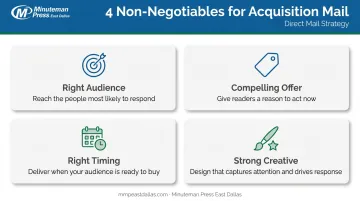
Every effective acquisition piece needs to nail four things:
- Right audience — the targeting work covered above
- Compelling offer: a reason to act now, not someday
- Right timing: aligned with seasonality, buying cycles, or follow-up sequences
- Strong creative: design that communicates quality before a word is read
Cold prospects don't know your brand. Your piece has roughly three seconds to establish who you are, what you're offering, and what they should do next.
Choosing the Right Format
Format choice affects cost, response rate, and the type of offer you can communicate effectively:
- Postcards: no envelope to open, immediate visibility, ideal for simple offers and local awareness campaigns. Available in six sizes from 3"×5" up to 6"×11", on stock ranging from 14pt coated to 120# gloss cover.
- Letters give you more room for context, urgency, and persuasion — better suited for higher-value propositions where the prospect needs information before acting.
- Dimensional or specialty pieces command attention and signal brand investment. The higher cost is justified for premium offers or high-value prospect segments.
Match format to your offer complexity and your budget — a postcard with a clear incentive will outperform a poorly executed letter every time.
Personalization at Scale
According to Lob's 2025 State of Direct Mail cited by USPS, 88% of marketers say personalized direct mail significantly improves response rates. Variable data printing makes this achievable at scale — each piece receives customized text, graphics, or imagery based on the recipient's data, without slowing down production.
For a Dallas HVAC company mailing to Mesquite homes over 10 years old, this could mean including the prospect's name, their specific neighborhood, and a seasonally relevant offer — all generated automatically from the mailing list.
Print Quality as a Trust Signal
The physical feel of a mailer communicates brand credibility before anyone reads the headline. Research published in the Journal of Retailing found that heavier haptic cues make a brand appear more competent — a finding that applies directly to paper weight and coating choices.
Finishing options that elevate a mailer's perceived quality include:
- Foil stamping and embossing
- Matte or gloss lamination
- Die-cutting for custom shapes
- Spot UV coating for visual contrast
- Heavier stock (16pt coated vs. standard 14pt)
Dallas-area businesses can handle all of this under one roof at Minuteman Press East Dallas — full-service design, printing, and mailing, from single-page postcards to four-color brochures with specialty coatings and finishes.
Integrating Direct Mail with Your Digital Marketing Mix
The Omnichannel Lift
Direct mail performs well on its own. It performs better alongside digital. Canada Post's Connecting for Action study found that integrated direct mail and digital campaigns produced 39% more time spent than digital-only campaigns and 10% higher brand recall when mail was paired with digital advertising.
When a prospect sees your offer in the mailbox and then encounters consistent messaging on social media or in their inbox, that second touchpoint feels like confirmation — not a cold pitch.
Practical Integration Tactics
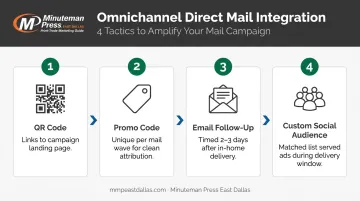
- QR codes — link to a campaign-specific landing page, not your homepage
- Unique promo codes — one code per mail wave keeps attribution clean
- Coordinated email timing — follow-up emails should arrive within 2-3 days of predicted in-home delivery
- Upload your mailing list as a custom audience to serve matching social ads during the same delivery window
Those tactics work well for planned campaigns. For even tighter timing, trigger-based mail takes integration a step further.
Trigger-Based Mail
More advanced integrations use digital behavior to trigger a physical send.
An abandoned cart, a high-intent page visit, or an email open without a click can all trigger a postcard to arrive at the prospect's home within days. This connects physical and digital touchpoints right when prospect interest peaks — without any manual campaign management once the automation is set up.
Measuring Results and Proving ROI
Three Metrics That Matter
Every acquisition mail campaign should track:
- Response rate — how many recipients took any action
- Conversion rate — how many of those became paying customers
- Customer acquisition cost — total campaign spend divided by new customers gained
The ANA benchmark for prospect list CPA is $97.74. Whether that's acceptable depends on your customer lifetime value — a business with a $5,000 average first transaction views that number very differently than one with a $50 average ticket.
Attribution Tools to Build In Before Printing
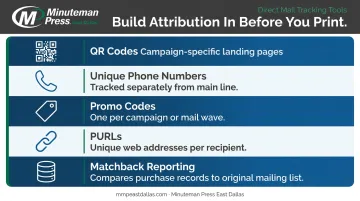
Attribution must be planned before the campaign goes to press — retrofitting tracking after the fact doesn't work.
- QR codes linked to campaign-specific landing pages (not your main website)
- Unique phone numbers routed to your main line but tracked separately
- Promo codes — one per campaign or mail wave
- PURLs (personalized URLs) — unique web addresses per recipient
- Matchback reporting — comparing purchase records against the original mailing list to identify converters who didn't use a tracked response mechanism
A/B Testing Your Way to Better Results
Test one variable at a time — headline, offer value, CTA wording, postcard size, or paper stock — then run two versions to equal-sized segments of the same list. Let the winning element carry forward into the next wave. Small, controlled tests protect your budget while systematically improving response rates. Over time, you build a performance baseline specific to your audience, which makes every subsequent campaign cheaper to optimize.
Common Mistakes That Kill Direct Mail Acquisition Campaigns
Three mistakes account for the majority of underperforming campaigns:
- Dirty or untargeted lists. Bad addresses waste print and postage with zero chance of return. The wrong audience wastes everything else. List hygiene and audience relevance are where campaigns are won or lost before a designer opens a file.
- Generic creative and offers. A "10% off" message with no connection to the recipient's situation will underperform a localized, specific offer every time. Cold prospects respond to relevance — they need to feel like the piece was meant for them, not whoever happened to be near the mailbox.
- No attribution plan. Many businesses mail thousands of pieces with no mechanism to identify what worked. Without tracking codes, dedicated URLs, or unique identifiers built in before printing, you cannot scale what's working because you don't know what's working. Attribution planning is part of campaign design, not an afterthought.
Frequently Asked Questions
What is a direct mail campaign?
A direct mail campaign sends physical promotional materials (postcards, letters, brochures) to a targeted list of recipients with the goal of driving a specific action like calling, visiting, or purchasing. Like digital advertising, it's a paid channel — but delivered physically to a named address.
Does direct mail marketing still work?
Yes. The ANA's 2023 benchmarks show prospect list response rates of 10.8% and house list rates of 15.6%, outperforming most digital display channels on direct response. Physical mail also generates stronger brand recall, particularly for cold prospects who haven't yet encountered your brand online.
What types of direct mail work best for customer acquisition?
Postcards work well for simple, visual offers and local awareness. Letters suit higher-value or more complex propositions where context matters. Dimensional pieces make strong first impressions for premium brands willing to invest in standout mail.
How do I target the right audience for a direct mail campaign?
Use demographic lists filtered by age, income, or household size; geographic radius lists around your location; or EDDM for full carrier-route saturation. More advanced campaigns use look-alike modeling to build prospect lists that mirror the profile of your best existing customers.
How do I measure the ROI of a direct mail campaign?
Use unique promo codes, QR codes tied to campaign landing pages, unique phone numbers, and matchback reporting. The critical rule: tracking must be built into the piece before it goes to print, not added afterward.
How much does a direct mail campaign cost for a small business?
Costs vary based on format, quantity, postage class, and design. Postcards and EDDM are the most cost-effective entry points for local businesses. Contact Minuteman Press East Dallas at 214-660-7003 for a quote — having your quantity, target area, and format in mind will speed up the estimate.