The practical case for personalized print isn't just theoretical. Physical mail already has a read-rate advantage: the USPS Household Diary Study FY 2022 found that 59% of existing-customer mail gets read, compared to just 23% for prospect mail. When that mail is also personalized to a donor's history, the gap between response and no response often comes down to whether the piece felt relevant.
Variable Data Printing (VDP) is the mechanism that makes relevance scalable. This article explains what VDP actually does, why it matters for nonprofit donor engagement, and how to put it to work without overcomplicating the process.
Key Takeaways
- VDP personalizes each printed piece — name, giving history, ask amount, images, QR codes — all within a single print run
- Donor mail that references a recipient's actual relationship with your organization outperforms generic appeals on response rate and average gift size
- VDP enables segmentation: one print run can produce different versions for new donors, lapsed donors, major donors, and prospects simultaneously
- Clean donor data is the foundation — the technology only works as well as the database behind it
- Skipping VDP compounds over time: unrecognized donors lapse, recapturing them costs more, and generic mail steadily weakens fundraising returns
What Is Variable Data Printing?
VDP (variable data printing) is a database-driven digital print process that lets you produce individualized pieces at scale — without reprinting from scratch for each recipient. A standard VDP job relies on three components working together: a donor database (often a structured spreadsheet or delimited file), a set of business rules that determine which data appears under which conditions, and a static design template with designated "variable" fields. Software merges these into a press-ready output file, and the press produces each piece with its unique combination of content.
The result: every printed piece shares the same design layout, but the variable fields — name, last gift amount, program reference, ask figure, QR code, imagery — change for each recipient.
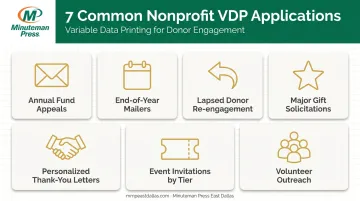
Where nonprofits typically use VDP:
- Annual fund donation appeals
- End-of-year giving campaign mailers
- Lapsed donor re-engagement letters
- Major gift solicitations
- Personalized thank-you letters and impact reports
- Event invitations segmented by donor tier
- Volunteer outreach communications
The mechanics matter less than what a donor actually experiences. Someone who opens a letter referencing their specific $150 gift to your food pantry program last November responds differently than someone who opens a form letter addressed to "Valued Supporter."
Key Advantages of VDP for Nonprofits
The three advantages below connect directly to outcomes nonprofits actually track: response rates, donor retention, campaign ROI, and cost per dollar raised.
Personalization That Turns Generic Appeals Into Donor Conversations
VDP personalization runs deeper than inserting a first name at the top of a letter. A well-executed VDP appeal can reference:
- The donor's previous gift amount and date
- The specific program or cause they've supported
- A tailored ask ("Your $75 gift last year helped serve 12 families — could you consider $100 this year?")
- Images matched to the donor's giving history
- A unique QR code linking to a personalized donation landing page
All of this gets produced from a single master template. The database does the personalization work; the design stays consistent.
According to Bloomerang's donor retention research, acquiring a new donor costs 5x more than renewing an existing one — and new-donor acquisition can cost two to three times the value of the initial gift, with organizations sometimes taking 12–18 months to break even. Keeping current donors giving is a far more efficient use of fundraising budget.
The same research notes that first-time donors who receive a personal thank-you within 48 hours are 4x more likely to give a second gift. That's not just about saying thank you — it's about making the donor feel like an individual, not a number.
KPIs this affects: direct mail response rate, average gift size, donor retention rate, cost per donor retained vs. acquired
When it matters most: End-of-year giving campaigns, major fundraising drives, and lapsed donor re-engagement — the moments when the decision to respond often hinges on whether the piece felt personal.
Donor Segmentation That Makes Every Campaign Relevant
A lapsed donor who gave three years ago needs a completely different message than a first-time donor who gave last spring. VDP lets a nonprofit produce both versions — and several more — within a single print run.
Blackbaud defines donor segmentation as dividing supporters into groups based on shared characteristics: giving level, frequency, program interest, event attendance, and acquisition source, among others. VDP takes those segments and executes them physically, swapping out content blocks automatically during production.
A typical segmented VDP run might include:
- First-time donors — welcome them to the mission, open with a lower ask, and lead with impact stories
- Lapsed donors — acknowledge their past support, address the gap directly, and give them a reason to return
- Major donors — report back on what their gift accomplished, raise the ask, and personalize the imagery
- Cold prospects — introduce the organization, keep the commitment ask low, and summarize key programs
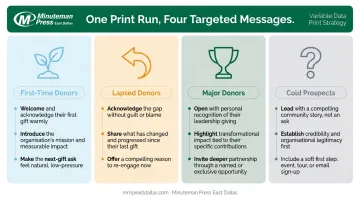
The nonprofit doesn't commission four separate design jobs or four separate print runs. One template, one database, one production job — the segments are just data fields.
The University of Georgia used this approach in their direct mail fundraising, and Blackbaud reports they increased Presidents Club donors by 910% year over year using advanced segmentation in fall and spring direct-mail campaigns. That result reflects a named case, not an industry average — but it illustrates what targeted segmentation can do when executed well.
KPIs this affects: campaign response rate by segment, cost per response, average gift by donor segment, volunteer conversion rate
When it matters most: Any organization with 200 or more donors in their database has enough variance in giving history to create meaningful segments. The more diverse the donor file, the more return segmentation delivers.
Cost-Effective Production Without Sacrificing Impact
Nonprofits managing tight communications budgets face a familiar problem: generic bulk mail is affordable but generates weak response, while fully custom materials perform better but cost more to produce at scale. VDP closes that gap.
All personalized pieces run as a single digital print job, so setup costs are distributed across the full quantity. There are no separate design commissions per audience segment, no separate press setups per version — just one production run where personalization is handled by data, not manual effort.
This changes the calculus for donor stewardship. Nonprofits that might hesitate to produce personalized thank-you letters or impact reports for each giving tier — because of the perceived cost — can now do so at close to the same cost as a generic mass mailing.
What makes VDP production cost-efficient:
- No separate design commissions per segment
- No separate press setups per version
- Digital production eliminates high per-piece costs at shorter run lengths
- Postage remains the same regardless of personalization level
The practical implication: nonprofits can increase the frequency and quality of donor touchpoints without a proportional increase in print budget — which directly supports long-term donor relationships.
KPIs this affects: print cost per piece, cost per donor touchpoint, number of donor communications per year, budget utilization for fundraising campaigns
What Happens When VDP Is Ignored
The risk of staying with generic mass appeals isn't hypothetical. Donor retention data tells the story clearly.
The Fundraising Effectiveness Project Q3 2024 report found donor counts down 5.3% and donor retention down 4.6% year over year. Only 13.8% of new donors were retained year-to-date. Even among repeat donors, retention sat at just 50.3%.
More recently, Bloomerang reports that recaptured lapsed donors decreased by 8.6% year over year, meaning organizations are losing ground on re-engagement too.
Generic mail accelerates this problem. A piece addressed to "Valued Supporter" tells the donor nothing about whether the organization knows them at all. It competes with every other piece in the mailbox on design alone, and the relationship signal disappears entirely.
The compounding effect is the real risk:
- Donors who feel unrecognized skip the response
- Unresponsive donors become lapsed donors
- Lapsed donors cost significantly more to re-engage than retained donors
- As the donor file erodes, acquisition spending rises to compensate
- Higher acquisition costs pull resources away from mission work
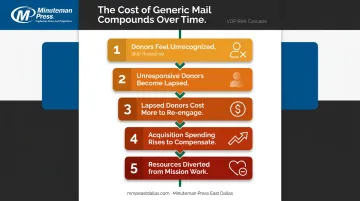
That last point compounds quietly. An organization can absorb one or two weak campaign cycles, but after several, the donor base shrinks, individual gift averages stagnate, and the cost to sustain fundraising volume climbs — often past the point where it crowds out the mission itself.
How to Get the Most Value from VDP
VDP is only as good as the data behind it. Before production begins, the donor database needs to be clean, current, and structured with the right fields.
Start With Clean Donor Data
Over 40 million Americans submit change-of-address orders to USPS annually, according to USPS OIG research. For nonprofits mailing at any scale, unverified addresses mean wasted postage and missed donor touchpoints. USPS Move Update requirements mandate that mailers using presorted or automation pricing update their lists within 95 days before the mailing date.
Key donor data fields to maintain for VDP:
- Full name and current mailing address (verified against NCOA records)
- Donation history — amounts, dates, and frequency
- Program or cause preferences
- Event attendance and volunteer activity
- Giving tier and acquisition source
Even a basic dataset covering these fields enables meaningful personalization and segmentation. More complete data unlocks more nuanced targeting.
Track Results and Refine Over Time
After each campaign, track response rates by segment and use those findings to sharpen the next run. The metrics worth watching include:
After each campaign, track response rates by segment and use those findings to sharpen the next run. The metrics worth watching include:
- Average gift size by donor segment
- Response rates tied to specific ask amounts
- Engagement lift from program-specific imagery or personalized QR codes
Nonprofits that treat VDP as an ongoing practice — not a one-time experiment — build progressively more effective donor communication over time. Segmentation sharpens as data accumulates, and each campaign performs better than the last.
Work With a Partner Who Understands Nonprofit Campaigns
For nonprofits in the Dallas-Fort Worth area, Minuteman Press East Dallas handles VDP campaigns end-to-end — from design and database preparation through printing, addressing, and USPS drop-ship. The shop has worked with local nonprofits including Dallas CASA, Hope Clinic of Garland, DFW Angels, Lone Star CASA, and Family Compass. That hands-on experience translates into practical familiarity with the pacing, budget constraints, and campaign goals that mission-driven organizations manage.
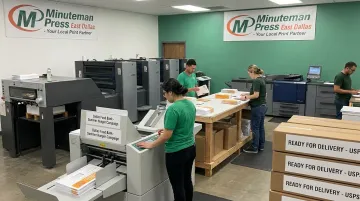
Working with a local printing partner means faster turnaround, direct communication throughout production, and a team that can help translate donor data into campaign-ready output — rather than managing a remote vendor relationship for time-sensitive fundraising materials.
Conclusion
Variable Data Printing gives nonprofits something that generic mass mail simply can't: the ability to treat each donor as an individual across every printed touchpoint. That distinction — between a form letter and a conversation — directly affects whether a donor responds, gives again, and stays connected to the organization over time.
The advantages build on each other. Cleaner data produces sharper segmentation, sharper segmentation drives higher response rates, and each campaign generates the insights needed to make the next one more effective. What starts as a single personalized mailing can evolve into a communications program that consistently outperforms generic outreach.
For nonprofits managing tight communications budgets, VDP offers a practical way to raise more per dollar spent — by making every piece relevant enough to act on. If your organization is ready to put that approach into practice, Minuteman Press East Dallas works with DFW nonprofits on variable data direct mail, from data setup through finished pieces.
Frequently Asked Questions
What does variable data mean in printing?
Variable data printing lets you change specific elements — names, images, donation amounts, QR codes — on each piece within a single print run, pulling information automatically from a donor database. The design template stays consistent; only the designated fields change per recipient.
What data should nonprofits collect to use VDP effectively?
The most valuable fields are full name, mailing address, donation history, cause preferences, and event attendance. Even a basic dataset enables meaningful personalization — more complete records simply allow for more precise segmentation.
What are examples of variable data printing for nonprofits?
Common applications include personalized donation appeal letters with each donor's previous gift amount and a tailored ask, segmented fundraising postcards with imagery matched to giving tier, personalized event invitations, and impact reports that reference the specific programs a donor has supported.
Can small nonprofits afford variable data printing?
Yes — because all personalized pieces are produced in one digital print run, setup costs distribute across the entire job. Per-piece costs are comparable to standard printing, making VDP practical even for organizations mailing a few hundred pieces rather than thousands.
How does VDP compare to email marketing for donor outreach?
Physical mail faces less inbox competition and earns higher read rates among existing donors. VDP combines that tangibility with the relevance donors expect from digital channels, which makes personalized print especially effective for major gift asks and end-of-year appeals.
How often should nonprofits use VDP in their donor communications?
Use VDP for high-stakes touchpoints: annual fund appeals, end-of-year campaigns, major gift asks, and personalized thank-you communications. Tracking response rates by segment after each campaign reveals which touchpoints perform best.