The inbox is crowded. Many nonprofit boards, looking at per-email costs versus per-mailer costs, conclude the math favors digital. That conclusion deserves scrutiny.
Direct mail revenue for nonprofits grew 9% in 2025. Gift counts grew 4%. This isn't a channel in decline — it's a channel being underestimated by organizations that compare unit costs without comparing response rates or retention outcomes.
This article explains what makes direct mail consistently effective in nonprofit fundraising, what happens when organizations cut it, and how to run campaigns that justify the investment with measurable results.
Key Takeaways
- Nonprofit fundraising email response averages 0.05%; direct mail to active donors returns $4.51 per $1 spent
- Physical mail builds donor connection that drives retention — and donor retention rates have been falling sector-wide for over a decade
- Direct mail pulls response from Boomers and Gen X especially — and digital follow-up amplifies results for all age groups
- Digital-only fundraising puts your revenue on a channel where 99.95% of emails go unanswered
- Segment your list, track response rates per mail piece, and treat every campaign as testable data — not a one-time send
What Is Direct Mail Fundraising?
Direct mail fundraising is the practice of sending physical printed materials — letters, postcards, brochures, or impact reports — through postal mail to current and prospective donors, with the goal of soliciting donations or deepening engagement.
It doesn't replace digital channels. It reaches donors where email and social media simply can't — on the kitchen counter, in the stack of mail they actually sort through by hand.
Direct mail serves specific fundraising outcomes:
- Donor acquisition — reaching new prospects who aren't on your email list
- Donor retention — keeping existing supporters engaged and giving year over year
- Major gift cultivation — providing a personal, tangible touchpoint for mid-level and high-value donors
Each of these outcomes requires a different format, message, and list — which is why direct mail programs are planned deliberately, not just printed and mailed.
Key Advantages of Direct Mail in Nonprofit Fundraising
The advantages below reflect measurable operational impact — response rates, retention trends, and campaign ROI — not abstract claims about awareness or brand building. Each advantage compounds when direct mail is applied consistently rather than deployed once a year as a seasonal afterthought.
Advantage 1: Response Rates That Actually Move Revenue
The comparison between email and direct mail isn't close. According to M+R Benchmarks 2026, nonprofit fundraising email averages a 0.05% response rate and $54 revenue per 1,000 emails sent. Direct mail to active donors, by contrast, returns $4.51 per dollar spent with an average gift of $120.
That gap has direct dollar implications. A list of 5,000 active donors produces dramatically different outcomes depending on channel:
| Channel | Response Rate | Avg. Gift | Revenue Benchmark |
|---|---|---|---|
| ~0.05% | Below $120 | ~$270 per 1,000 sent | |
| Direct mail (active donors) | Significantly higher | ~$120 avg. gift | $4.51 ROI per $1 spent |
The ROI difference also varies sharply by audience segment:
- Active donors: $4.51 per $1 spent
- Lapsed donors: $0.90 per $1 spent
- Prospects: $0.41 per $1 spent
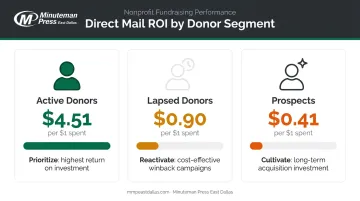
This means mailing indiscriminately destroys the economics. The channel is powerful — but only pointed at the right audience.
When it matters most: End-of-year campaigns, emergency appeals, and major gift solicitations where urgency needs to cut through digital noise.
Advantage 2: Tangible Connection That Drives Retention
A physical piece of mail does something email cannot — it occupies space. Donors hold it, read it at their own pace, and often set it aside to act on later. USPS Office of Inspector General research found physical mail produced stronger engagement, emotional intensity, and long-term memory encoding than digital stimuli.
Those engagement effects translate directly to retention outcomes — and the sector has a serious retention problem. FEP/AFP data for Q4 2024 shows:
- Dollars raised: +3.5% year over year
- Donor counts: -4.5% year over year
- Donor retention: -2.6% year over year
Nonprofits are raising more from fewer donors. That increases concentration risk. When a long-term supporter quietly stops giving, there's no email open rate metric that will warn you — because they were probably ignoring the emails for months before they lapsed.
A mailed touchpoint — a thank-you letter, a stewardship report, a personal appeal — signals that the organization sees the donor as a person, not an address in a database. For mid-level donors especially, that distinction is often what separates a one-time gift from a multi-year relationship.
When it matters most: First-time donor conversion, mid-level donor stewardship, and any retention-focused campaign targeting supporters who haven't responded digitally in 90+ days.
Advantage 3: Direct Mail Multiplies Your Digital Campaigns
Direct mail and digital aren't competing channels — they reinforce each other. When a donor receives a physical appeal and then sees a follow-up email or social post carrying the same message, the combined impression lands with more credibility than either channel alone.
The data supports running both simultaneously. In 2025, M+R reported:
- Online revenue: +15%
- Direct mail revenue: +9%
- 37% of online revenue arrived in December — the same window when year-end mail lands in mailboxes
That overlap isn't coincidental. Mail sent in November builds recognition that online campaigns in December convert into gifts.
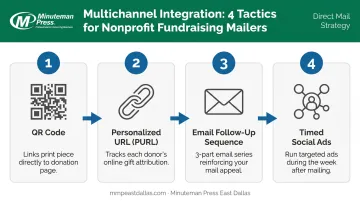
Practical integration tactics:
- Include QR codes linking to campaign-specific donation pages
- Use personalized URLs (PURLs) to attribute online gifts back to the mailing
- Follow a mail drop with a 3-part email sequence referencing the physical piece
- Time social ads to run during the week after a mailing hits
This multi-channel approach matters most for Giving Tuesday, year-end drives, and donor reactivation campaigns — situations where repeated exposure across channels meaningfully increases response probability.
What Happens When Nonprofits Skip Direct Mail
Going fully digital doesn't eliminate costs — it trades one type of attrition for another.
With email as the only channel, the math compounds against you. A 12% annual unsubscribe rate means a 5,000-person list loses 600 reachable donors every year before a single email is sent.
Add 4% bounces and you're losing 800 contacts annually — donors who might still be giving if a mailed piece had reached them.
Stewardship gaps carry their own price tag. When acknowledgments only arrive by email, a meaningful percentage of donors never see them. A donor who gives $500 and receives no tangible recognition has no reason to give again next year.
The cost trade-off looks like this:
| Factor | Digital-Only Approach |
|---|---|
| Short-term savings | Lower per-piece cost vs. mail |
| Long-term cost | Lost lifetime value from donors who feel unrecognized and lapse |
| Hidden risk | No fallback channel when email lists degrade |
Donor lifetime value — not single-gift revenue — is the correct unit of analysis. A retained mid-level donor giving $250 annually for 10 years generates $2,500. Cutting mail to save $5 in postage while losing that donor is a poor trade by any measure.
Sector data makes the risk concrete: Q3 2024 saw small donors under $100 decline 12.4% year over year, while micro-donors represented 52.4% of all donors. That base erodes quickly without consistent, multi-channel touchpoints.
How to Get the Most Value from Direct Mail Fundraising
Segment Before You Send
Mailing your entire database the same piece wastes budget and dilutes results. Effective campaigns start with list segmentation:
- Active donors (gave in last 12 months): Highest ROI; mail first and most frequently
- Lapsed donors (gave 13–36 months ago): Test with a reactivation appeal before committing to full volume
- Prospects (never gave): Mail sparingly; ROI of $0.41 per $1 spent means test budgets only
Further segment active donors by giving history and ask amounts. A donor who gave $100 should receive a different ask than one who gave $500.
Invest in Print Quality
A mailer printed on flimsy stock with muddy images signals low credibility before the first word is read. Professional-grade cardstock — 14pt or 16pt coated stock, sharp four-color printing, clean typography — signals legitimacy.
For DFW-area nonprofits, Minuteman Press East Dallas manages direct mail campaigns from design through postal drop — including list building, addressing, and USPS-compliant delivery. Variable data printing supports personalized salutations and customized ask amounts, giving each piece a one-to-one feel without one-off production costs.
Track Results Like a Digital Campaign
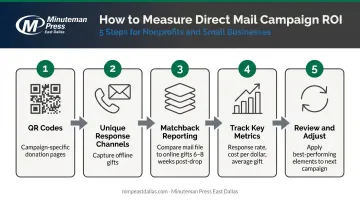
Direct mail attribution is measurable when set up correctly:
- Include QR codes routing to campaign-specific donation pages
- Use unique phone numbers or reply envelopes to capture offline responses
- Run matchback reporting — compare your mail file against new online gifts in the 6–8 weeks following a drop
- Track response rate, cost per dollar raised, and average gift for every campaign
- Review and adjust — what story, design, or ask amount drove the best outcome becomes the baseline for the next mailing
After enough campaigns, you'll have your own benchmarks. Those internal numbers are more useful for planning than any industry average.
Conclusion
Direct mail earns its place in nonprofit fundraising by doing three things at once: reaching donors where digital cannot, building personal connection that supports retention in a sector where donor counts are falling, and strengthening every other channel running alongside it.
The advantages grow over time when direct mail is applied consistently — segmented properly, produced professionally, and measured rigorously — rather than dusted off for a single year-end appeal.
For nonprofits in Dallas-Fort Worth, that consistency starts with print that's done right. Minuteman Press East Dallas works with local nonprofits — from direct mail postcards to full donor appeal packages — to help organizations put something tangible in donors' hands. The mission lasts longer than any single campaign. The mail that supports it should too.
Frequently Asked Questions
What is the success rate of direct mail marketing?
For nonprofit fundraising, direct mail to active donors returns $4.51 per $1 spent with an average gift of $120, according to M+R Benchmarks 2026. Success rates vary by list quality and segmentation — active donor files consistently outperform lapsed donor or prospect lists.
What is the 33% rule for nonprofits?
The 33% rule refers to the IRS public support test, which generally requires at least one-third of a nonprofit's total support to come from public sources over a five-year period. Channel diversification — including direct mail — helps protect that public support base.
Is direct mail still effective for fundraising in 2025?
Yes. M+R Benchmarks reported nonprofit direct mail revenue grew 9% and gift counts grew 4% in 2025. Public media nonprofits saw particularly strong results, with average direct mail ROI of $9.02 and active-donor ROI of $15.42 per dollar spent.
Does direct mail only work for older donors?
No. USPS research found 82% of millennials say receiving physical mail still holds significant value, and 66% used marketing mail as a prompt to go online. Direct mail works across generations — especially when it connects donors to digital giving options via QR codes or campaign URLs.
How much does a nonprofit direct mail campaign cost?
Costs vary by format, quantity, paper stock, and postage class. Nonprofits qualifying for USPS Marketing Mail rates pay less per piece than standard commercial mailers. Focus on cost per dollar raised rather than cost per piece — that figure differs sharply between active donor files and cold prospect lists.
How do I measure the ROI of a direct mail fundraising campaign?
Track four core metrics: response rate, gross revenue, cost per dollar raised, and donor retention rate. Add QR codes and campaign-specific donation pages to attribute online gifts to the mailing, then compare your donor file before and after each campaign to gauge retention impact.