For financial advisors, that math matters. A well-designed postcard lands in the hands of a qualified prospect with zero competition from the delete key.
That said, postcards aren't a magic bullet. One send rarely converts a stranger into a client. What works is a consistent, targeted campaign paired with smart follow-up. This article covers 9 actionable postcard ideas — plus the strategy behind making them work.
Key Takeaways
- Direct mail averages a 9% response rate for house lists — far above email's typical 1%
- Effective postcards lead with a pain point, not a product pitch, and include one strong CTA
- List targeting by age, income, and ZIP code sharply improves lead quality and reduces wasted spend
- Monthly mailing over 6–12 months builds name recognition and catches prospects at the right moment
- Follow up by phone or QR landing page the same week postcards arrive
Why Postcards Still Work for Financial Advisors
The Physical Mail Advantage
Email competes with hundreds of other messages daily, while the average household mailbox sees a fraction of that volume. According to the USPS Household Diary Study FY2022, mail from prospect relationships is eight times more likely to generate a response than unsolicited email — 16% versus 2%.
Postcards have an additional edge over envelopes: no friction. The message is visible the moment someone picks it up. For a financial advisor trying to reach cold prospects, that instant exposure is worth a lot. There's no subject line to optimize, no email filter to clear.
The Trust Factor
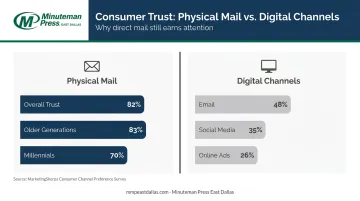
Physical mail carries credibility that digital channels have struggled to match. A MarketingSherpa survey of 1,200 U.S. consumers found 82% trusted print ads when making a purchase decision, outranking every digital channel tested. Trust in direct mail held across age groups:
- 83% of older generations trust print advertising
- 70% of Millennials trust print advertising — higher than any digital channel tested
For financial services — where prospects are deciding who to trust with their retirement savings — that credibility gap is hard to ignore. A postcard in the mailbox signals intentionality in a way a forwarded email never can.
What Makes an Effective Financial Advisor Postcard
Design for Credibility
Overly colorful or gimmicky designs signal cheap, and cheap is the last impression a financial advisor wants to make. Clean layouts with strong headlines, generous white space, and high-quality stock communicate professionalism before a prospect reads a single word.
Stock selection is part of that equation. Card weight matters more than most advisors realize. Options to consider:
- 14pt coated stock — standard weight, good for high-volume mailings
- 16pt C1S/C2S — heavier, more substantial feel that signals quality
Minuteman Press East Dallas offers both, so the stock you choose matches the impression you want to make.
Write to a Pain Point, Not a Product
Nobody wakes up wanting "investment portfolio management services." They wake up worried about running out of money in retirement, or unsure whether their savings will survive the next market downturn.
The AIDA framework — Attention, Interest, Desire, Action — maps directly to postcard copy:
- Attention: A headline that names the fear ("Will your savings outlast you?")
- Interest: One line that makes the fear more concrete
- Desire: The outcome your service delivers
- Action: A single, clear next step
One CTA, Done Well
Multiple calls to action split attention and dilute response. Pick one — call for a free review, scan the QR code, visit the landing page — and make it impossible to miss. QR codes are effective for tracking response: according to ANA's 2023 Response Rate Report, 82% of direct mail marketers now use QR codes or unique URLs to track response rates.
Personalize with VDP
Variable Data Printing lets you print each recipient's name and personalized messaging directly on the postcard. Addressing someone as "Dear Dallas Homeowner, 55+" is measurably warmer than "Dear Resident." Personalization can improve direct mail ROI by 10–30%, according to USPS data.
Minuteman Press East Dallas supports full VDP campaigns that change text, graphics, and content from piece to piece. Segment your list by age bracket, ZIP code, or income level, and each group receives messaging written specifically for them.
9 Postcard Marketing Ideas for Financial Advisors
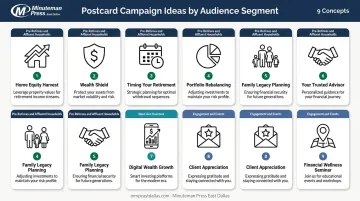
The ideas below span different client personas and life stages — entries 1–6 skew toward pre-retirees and affluent households, while #7 targets younger investors specifically. Pick what matches your niche, or test multiple ideas across segmented lists.
1. Retirement Planning Postcard
The highest-intent segment. Prospects nearing retirement are actively thinking about their financial future and are receptive to a message that validates their concern.
What works: "Free retirement readiness review — no obligation" as the CTA. The offer is specific, low-risk, and directly relevant to where the prospect is mentally.
2. Free Portfolio Review Offer
A complimentary portfolio review removes the barrier for prospects who are dissatisfied with a current advisor or anxious about recent market performance. The offer has to feel genuinely useful — not a sales call dressed up as a freebie. Lead with what they'll walk away with:
- A second opinion on their current allocation
- A clearer picture of where they stand
- Peace of mind heading into a volatile market
3. Market Volatility Card
When markets drop, anxiety spikes. A postcard that positions the advisor as "a steady voice in uncertain times" lands differently than a generic services pitch. Language that acknowledges the volatility and invites a no-cost conversation ("Let's talk through what this means for your plan") converts better than promotional copy during these moments.
4. Financial Security and Wealth Management
Target affluent households and business owners with messaging focused on outcomes — protecting what they've built, having a plan for every risk — rather than product features. Pair this card with a mailing list filtered by estimated household income for the cleanest targeting. The more specific the list, the less you're paying to reach households who aren't a fit.
5. Long-Term Care / Making Savings Last
This card addresses one specific fear: outliving savings or facing large medical costs in later life. Position the advisor as someone who plans for the unexpected — covering Medicare gaps, long-term care insurance, and income sustainability. Concrete language ("What would a $100,000 care event do to your retirement plan?") outperforms vague references to "financial security."
6. Estate Planning and Document Review
Only 32% of Americans have a will, down from 38% in 2023, according to Caring.com's 2024 Wills Survey. A "free document review" offer gives the advisor a genuine reason to start a conversation and addresses a real gap most pre-retirees already sense exists.
7. Next-Generation Investor Outreach
Cerulli projects $124 trillion in wealth will transfer through 2048, with Millennials expected to inherit the largest share — $46 trillion. Advisors who reach younger investors now are positioning for long-term relationships.
The messaging must match where they actually are. Generic retirement planning language won't land — instead, speak to their current stage:
- Paying off student loans while starting to invest
- Buying a first home and navigating competing financial priorities
- Getting a financial plan in place before major life changes hit
A tone that feels relevant to their moment converts. Generic wealth management copy doesn't.
8. Educational Value-Add Postcard
A card that delivers something useful — an IRA contribution deadline reminder, a short tax-season checklist, a single financial planning tip — gets kept, sometimes shared, and builds credibility before a prospect ever calls. Unlike direct-response pieces, these aren't designed for an immediate call. Plan 3–4 of these over a 6-month period to build name recognition before the ask arrives.
9. Seminar or Workshop Invitation
Event invitations are among the highest-converting postcard formats because they give prospects a specific action and a low-commitment entry point. Three elements drive the strongest results:
- Hard event date — creates urgency that a general offer can't replicate
- Limited seating language — scarcity nudges fence-sitters to register
- QR code registration link — removes friction from the response step
Of all nine formats, seminar invitations typically see the highest response rates.
How to Build Your Mailing List and Maximize Results
Choosing Between EDDM and a Targeted List
Two approaches, different use cases:
- EDDM (Every Door Direct Mail): USPS delivers to every address on selected carrier routes at $0.247 per piece. Minimum 200 pieces per mailing. Best for geographic saturation — blanketing affluent neighborhoods near your office or a seminar venue. No individual addressing required.
- Third-party list vendors: Lists filtered by age, estimated household income, ZIP code, or homeowner status. Better for precise demographic targeting — reaching households aged 55–65 with income above a specific threshold. More expensive but cleaner for niche campaigns.
Minuteman Press East Dallas handles both: they can build a targeted list based on your audience and geography, or work with your existing list — and manage everything from design through USPS submission.
Follow-Up Is Where Most Advisors Drop the Ball
Once your list is set and postcards are in the mail, the follow-up is what actually converts prospects. A postcard rarely closes a client on its own. The week your postcards arrive, follow up with:
- A phone call to any prospects you can identify
- A ringless voicemail to known numbers
- An email if you have addresses from your existing database
- A retargeting ad if you're running digital alongside direct mail
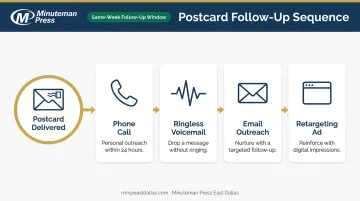
The goal is to reach the same prospect across multiple touchpoints within a narrow window.
Test, Track, and Stay Consistent
Plan to mail monthly for at least 6–12 months. Consistent repetition builds name recognition and increases the odds of reaching a prospect exactly when they're ready to act. Track every campaign using:
- Unique phone numbers per mailing
- QR codes with UTM parameters
- Personalized URLs (PURLs) per list segment
Change one variable at a time (headline, offer, or image) so you know what's actually driving response.
Compliance Before You Mail
Financial advisor postcards that reference investment services, performance, or specific financial products are considered retail communications under FINRA Rule 2210 — meaning they must be approved by a qualified registered principal before mailing. The SEC Marketing Rule applies separately to investment adviser advertisements. Run every postcard through your compliance review process before submitting to print.
Minuteman Press East Dallas provides digital proofs via email before any print run begins, so advisors and compliance teams can review and approve before production goes live.
Frequently Asked Questions
How much do marketing postcards cost?
Costs vary by quantity, size, paper stock, design, and postage class — EDDM postage runs $0.247 per piece through USPS. Design, print, and mailing totals differ by vendor and project scope. Contact Minuteman Press East Dallas at 214-660-7003 for a quote on your campaign.
What size postcards work best for financial advisor marketing?
Jumbo formats (6×11) command more visual attention in the mailbox and offer room for detailed messaging. Standard sizes (5.5×8.5) work well for high-volume campaigns where per-piece cost matters. Minuteman Press East Dallas offers both formats, plus 4×6, 5×7, and 6×9 options to fit any budget or campaign goal.
How often should financial advisors send postcards?
A monthly cadence for at least 6–12 months is the practical minimum. Repetition builds name recognition. Most prospects won't respond the first time they see your card, but many act on the third or fourth contact.
How do I build a mailing list for postcard marketing?
EDDM targets every address on a carrier route with no list required. For more precise targeting, third-party lists can filter by age, income, and ZIP code. Minuteman Press East Dallas can build a targeted list from your criteria or work with one you already have.
Should I include a QR code on my financial advisor postcard?
Yes. QR codes make it easy for prospects to act immediately — registering for a seminar, visiting a landing page, or booking a call. They also provide measurable response data you can track campaign-to-campaign.
Do financial advisor postcards need compliance review?
Yes. Postcards distributed to more than 25 retail investors within 30 days are retail communications under FINRA Rule 2210 and require principal approval before mailing. Investment advisers are also subject to the SEC Marketing Rule. Review every postcard through your compliance process before printing.