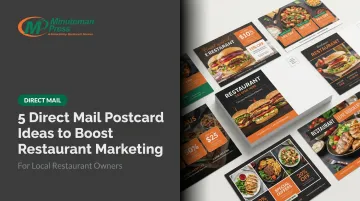
That's the opportunity. A well-designed postcard lands directly in the hands of households within a few miles of your front door — no algorithm, no inbox filter, no scroll-past. USPS-commissioned research from Temple University found that physical ads produced stronger memory recall, more time spent viewing, and stronger emotional response compared to the same content shown digitally. For local restaurants trying to fill tables, that's a meaningful edge.
This guide covers five postcard ideas that actually drive visits, the design principles that make them work, and how to get the right cards into the right mailboxes.
Key Takeaways
- Direct mail postcards don't require an "open" — the offer is visible the moment someone checks the mail
- Five proven ideas: coupon offers, seasonal promotions, loyalty rewards, new menu announcements, and social proof campaigns
- Every postcard needs one clear CTA, one strong image, and a time-sensitive offer
- EDDM lets Dallas restaurants blanket nearby neighborhoods at $0.247 per piece (USPS retail rate)
- Minuteman Press East Dallas handles design, print, and mailing in one place. Call 214-660-7003 for a quote.
Why Direct Mail Postcards Work for Restaurant Marketing
Most marketing channels require your audience to take an action before they see your message — opening an email, clicking an ad, scrolling to your post. Postcards skip all of that. The offer is right there, face-up, the second someone pulls their mail.
That visibility matters. A 2022 ANA study found that letter-sized direct mail delivered 112% ROI compared to 93% for email — despite email being used by 82% of marketers versus only 38% for direct mail. Restaurants have a specific structural advantage: your ideal customer already lives nearby. You're not trying to reach someone in another state — you're trying to reach the household three streets over that hasn't tried your enchiladas yet. Postcards are built for exactly that.
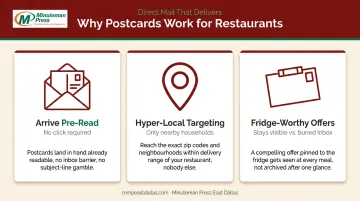
Three reasons postcards work particularly well for restaurants:
- Arrive pre-read — no inbox, no click, no scroll required
- Target only households near your location, so every dollar reaches a realistic customer
- A strong offer gets pinned to the fridge instead of buried in a junk folder
5 Direct Mail Postcard Ideas to Boost Restaurant Marketing
These ideas work whether you run a taco spot in Garland, a family diner in Mesquite, or an upscale restaurant off Lower Greenville. Each one targets a specific outcome — new visits, re-engagement, or word-of-mouth — and gives you data to measure what worked.
Coupons and Limited-Time Offers
A physical coupon does something a promo code doesn't — it lives in someone's home. It sits on a counter, rides in a wallet, and stays visible until it's redeemed or expires.
Offer formats that work well on postcards:
- 15–20% off the entire check
- Buy one entrée, get one at half price
- Free appetizer with any two entrées
- $5 off a first order for new customers
The mechanics matter as much as the offer itself. Set a specific expiration date — "Valid through [Month/Day]" — to create urgency rather than an open-ended maybe.
For tracking, ask customers to bring the card in, or include a unique promo code if you take online orders. That data tells you exactly which neighborhoods responded and whether the campaign paid for itself.
Seasonal Promotions and Event Invitations
Timely campaigns outperform evergreen ones because recipients can feel the relevance immediately. A "Summer Happy Hour" postcard in June lands differently than a generic "Visit Us" card.
Seasonal angles that translate well to restaurant postcards:
- Holiday family meal bundles (Thanksgiving, Christmas, Mother's Day)
- Back-to-school specials targeting family households
- Summer happy hour promotions for after-work crowds
- Valentine's Day prix fixe dinner invitations
Event-based postcards — grand openings, anniversary celebrations, live music nights — work especially well as physical invitations. Social media posts get scrolled past in two seconds. A postcard sitting on the kitchen counter keeps the event visible for days. Include all the details upfront: date, time, address, what's included, and any reservation instructions.
Loyalty Rewards and VIP Customer Appreciation
Most restaurant marketing focuses on acquisition. Retention is often more cost-effective, and postcards are a strong tool for it — especially for re-engaging customers who've drifted away.
Variable data printing makes this approach much more personal. Each card can feature the recipient's name, a reference to their favorite dish, or a personalized offer like "We miss you, Sarah — here's a complimentary drink on your next visit." Minuteman Press East Dallas offers variable data printing that can customize each piece individually, turning a mass mailing into something that reads like a one-to-one message.
Target customers who haven't visited in 60–90 days with a specific hook:
- A complimentary dessert or drink
- Bonus loyalty points on their next visit
- An exclusive "VIP early access" offer before a new menu launch
That emotional signal — the restaurant noticed, and reached out — carries more weight than the face value of any discount.
New Menu Item or Restaurant Announcement
A photo-forward postcard is one of the cleanest ways to drive curiosity. When someone sees a beautifully photographed dish they've never tried, that image does the selling.
One rule: one hero image. A single, high-resolution photo of your new dish will outperform a card crammed with four or five menu photos every time. The goal is to create one memorable impression, not a catalog.
Pair the reveal with an introductory offer to give people a concrete reason to visit soon:
- 50% off the new dish for the first two weeks
- A complimentary side when ordering the new item
- Free dessert with any new menu entrée during launch week
Grand opening campaigns follow the same logic. A striking image, a limited-time offer, and an EDDM drop to every household within three miles of your location is a proven formula for generating opening-week foot traffic.
Social Proof and Review Spotlight
Your customers are more persuasive than your marketing copy. A real, specific quote from a genuine diner carries weight that no amount of self-promotional language can match.
Keep the featured review short — one or two sentences that capture something specific:
"Best birria tacos I've had in Dallas. I drove 20 minutes just to come back." — James T.
Pair it with a strong CTA: "See what the buzz is about — bring this card for 15% off your next visit." To reinforce credibility, layer in one or more of the following:
- A star rating graphic pulled from Google or Yelp
- A press mention or local media quote
- Your current Google review count
For restaurants with strong online reviews that aren't translating into repeat visits, this format closes the gap between digital reputation and in-person traffic.
Design Tips That Make Restaurant Postcards Actually Work
Good design doesn't mean beautiful design — it means clear, action-driving design. These are the principles that separate postcards that get results from ones that get recycled.
The Single CTA Rule
Every postcard should direct the reader toward one action: bring this card in, call to reserve, scan this QR code to order online. USPS guidance on effective direct mail consistently emphasizes a clear, singular call to action. When a card asks readers to do three different things, most will do none of them.
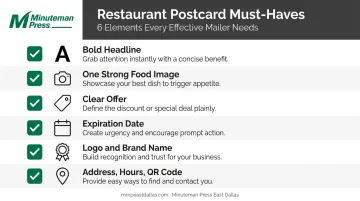
Essential Elements on Every Card
- Headline — bold, benefit-driven, immediately readable
- One strong image — professional food photography on gloss or coated stock
- The offer — set in a contrasting color block or bold font so it can't be missed
- Expiration date — never omit this; it creates urgency
- Logo and brand name — with enough breathing room to be recognized
- Address, hours, and contact info — including a QR code if you take online orders
Common Mistakes to Avoid
- Use one hero food shot — multiple images split attention and weaken impact
- Keep copy minimal; postcards get a 2-second scan, not a close read
- Set a specific expiration date — "limited time" doesn't create the same urgency
- Make the CTA unmissable; if readers have to hunt for next steps, they won't take any
For finishing, gloss and coated stocks (like 14pt C2S) make food photography pop. Minuteman Press East Dallas prints postcards on gloss cover stocks up to 120# with lamination available — a practical option when food photography is doing the heavy lifting in your design.
How to Target the Right Households for Your Campaign
EDDM: The Most Cost-Efficient Option for Local Restaurants
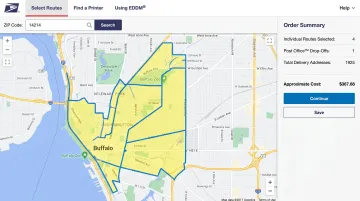
USPS Every Door Direct Mail lets you send to every household in selected carrier routes — no mailing list required. Current EDDM Retail postage runs $0.247 per piece for flats up to 3.3 oz (per USPS Notice 123, effective April 26, 2026). Commercial rates drop as low as $0.242 per piece depending on entry point.
For a Dallas restaurant, that means reaching every household within a 3–5 mile radius at a fraction of typical postage costs. The USPS EDDM Online Tool lets you map routes by zip code and filter by income level, household size, and age — useful when you're promoting a family meal deal versus a high-end tasting menu. Minimums start at 200 pieces per mailing, with up to 5,000 per day per zip code.
Targeted Custom Lists
When saturation isn't the goal — say, you're running a loyalty reactivation campaign or a VIP-only event — a custom mailing list lets you reach specific demographics more precisely. Minuteman Press East Dallas builds targeted lists based on your audience profile and geography, or works with a list you already have.
Common use cases for custom lists include:
- Reactivating lapsed customers with a "we miss you" offer
- Promoting a private event or seasonal menu to high-income households
- Targeting new movers in your delivery zone before competitors do
Minuteman Press East Dallas handles both EDDM saturation mailings and targeted custom list campaigns, plus design and print — so Dallas restaurant owners run the whole campaign through one vendor instead of juggling three.
Conclusion
A direct mail postcard campaign doesn't require a big budget or a marketing team. It requires a clear offer, a clean design, and the right households on the receiving end. When those three things align, postcards drive real foot traffic — customers who walk through your door, not just click past your ad.
Start with one campaign idea from this list, track your redemptions, and scale what works. If you're a Dallas-area restaurant owner ready to test this, call Minuteman Press East Dallas at 214-660-7003 to get a quote on custom restaurant postcard printing and mailing services. They handle design, print, and delivery — from concept to mailbox.
Frequently Asked Questions
Does restaurant postcard marketing still work?
Yes. Physical mail stands out in a crowded digital environment, and USPS/Temple University research shows that physical ads generate stronger memory recall and emotional response than their digital equivalents. When paired with a clear offer and local targeting, postcards remain a cost-effective channel for driving foot traffic.
Why do restaurants use postcard marketing?
Restaurants use postcards to reach nearby households with a tangible offer — no inbox filter, no algorithm required. It builds local brand awareness and drives both first-time visits (via coupons and new menu announcements) and repeat visits (via loyalty and seasonal campaigns).
What is the 30/30/30 rule in restaurant marketing?
In restaurant contexts, the 30/30/30 rule refers to cost-control benchmarks — food cost, labor cost, and overhead each at roughly 30% of revenue. It's a financial management framework, not a direct mail strategy. It has no established connection to direct mail or postcard marketing.
What should a restaurant postcard include?
Every effective postcard needs a bold headline, one high-quality food image, a single clear offer with an expiration date, one call-to-action, your logo, and full contact/location details. Keeping it clean and scannable is more important than fitting in more information.
How often should restaurants send direct mail postcards?
There's no universal benchmark that fits every restaurant. Align campaigns with natural timing — seasonal promotions, holiday periods, new menu launches — and track response rates to find your optimal cadence. Consistent, measured mailing will outperform sporadic sends every time.
What size postcard is best for restaurant direct mail?
A 4×6 qualifies for First-Class postcard rates ($0.61 retail) and suits simple offers, while 6×9 and 6×11 formats ship as Marketing Mail or EDDM flats and give more room for food photography. Choose based on your budget and how much visual space your design requires.